Ask most pilots to recite the ADS-B rule and they'll get you something close. Ask them to explain it when a TFR brief throws around "transponder" and "ADS-B" like they're the same thing, and things get wobbly fast.
That's the real test. Not whether you memorized 14 CFR 91.225. Whether you can take a system most pilots treat as a black box that occasionally yells at them and turn it into something you actually understand.
This comes up on practically every checkride oral, and it keeps mattering every time you fly into unfamiliar airspace. Get the ADS-B out requirements straight and the rest of the system falls into place.
What ADS-B Actually Does
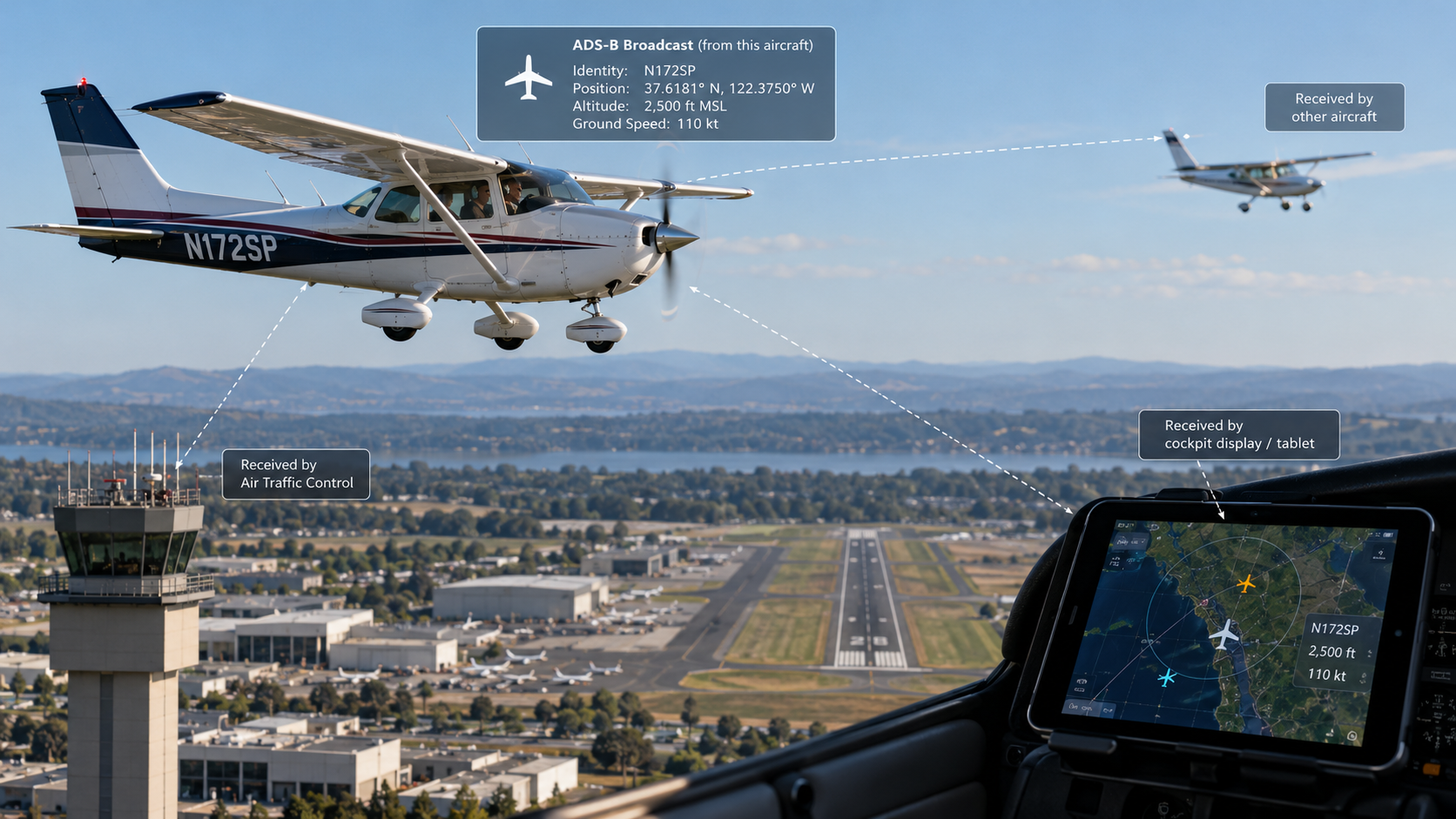
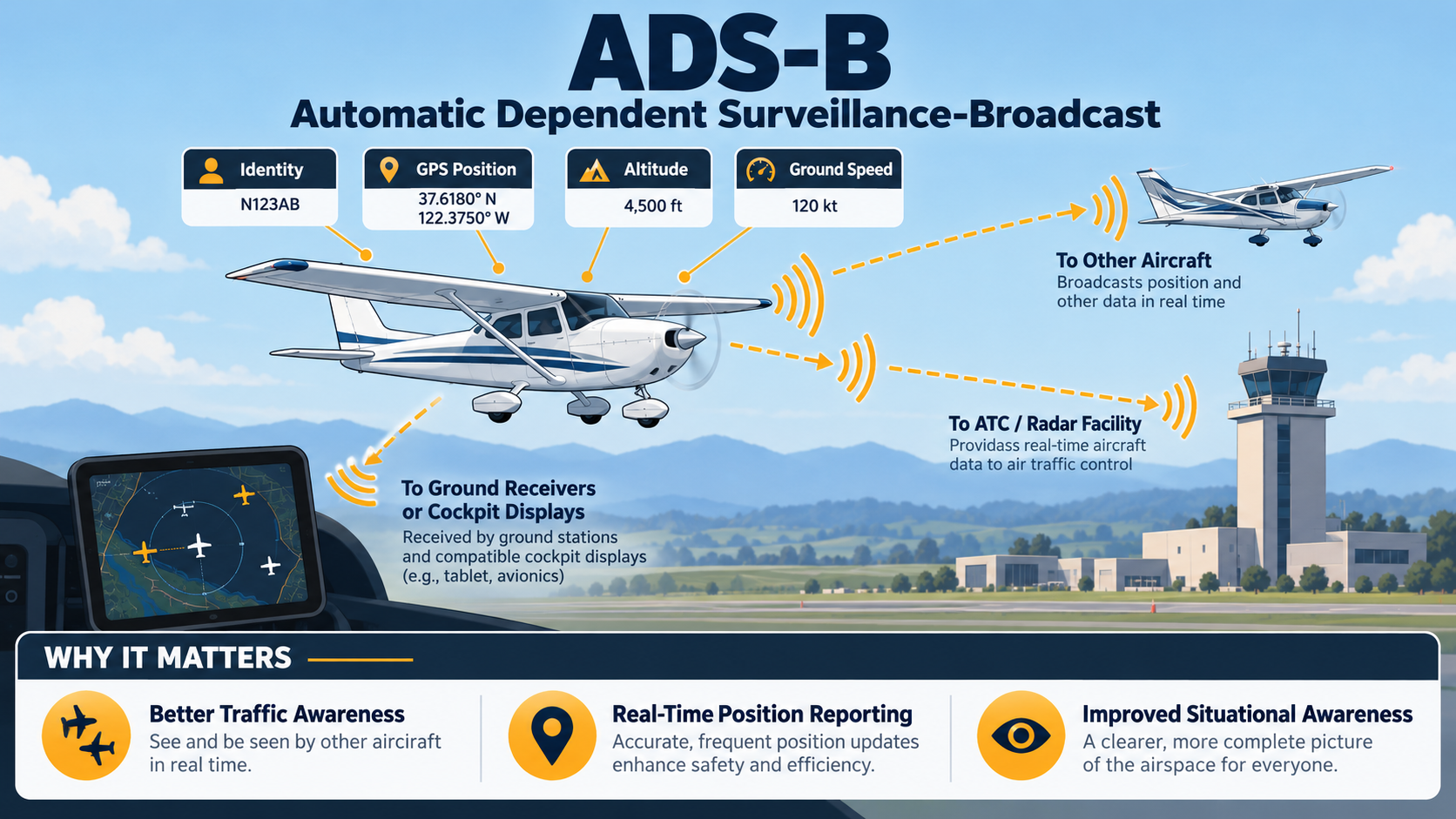
Automatic Dependent Surveillance–Broadcast is the FAA's replacement for relying on ground radar alone. Instead of a radar site painting your airplane every few seconds, your aircraft broadcasts its own GPS position, altitude, ground speed, and other data once per second to ground stations and nearby traffic.
That's the "automatic" and "dependent" part. Automatic, because it transmits without a controller asking. Dependent, because the accuracy depends entirely on your own GPS source.
There are two halves to the system, and this is where pilots start mixing things up:
ADS-B Out broadcasts your aircraft's position and data to ATC and other equipped aircraft. This is the half with the regulatory teeth.
ADS-B In receives weather and traffic data and displays it in the cockpit. This is the half that makes a portable receiver feel like a superpower the first time you see traffic targets pop up on your tablet.
Out is required. In is optional, and most trainers don't have it factory-installed, which is exactly why pilots get confused about what their handheld receiver actually gives them.
Where ADS-B Out Requirements Apply
This is the part worth knowing cold, because flying into the wrong airspace without the right equipment is an easy way to end up in a conversation with ATC you didn't want to have.
Where the Requirement Applies
ADS-B Out is required in the same general airspace where a Mode C transponder has historically been required, plus a few additions. Per 14 CFR § 91.225, that includes Class A, B, and C airspace, Class E airspace at and above 10,000 feet MSL (excluding the airspace at and below 2,500 feet AGL), and within 30 nautical miles of airports listed in appendix D to Part 91, measured from the airport's reference point and up to 10,000 feet MSL. It also applies over the Gulf of America above 3,000 feet MSL, out to 12 nautical miles from the coastline.
It helps to tie this to something you already know. If you're familiar with the Mode C veil around Class B airports, ADS-B Out basically rides the same footprint, with a few extra zones layered in. That mental shortcut does more work than reciting the regulation line by line.
Equipment Performance Standards
The equipment itself has to meet separate performance standards under § 91.227, covering things like the type of GPS source feeding the system and the broadcast equipment's accuracy. You don't need to memorize every line of that section, but it's worth knowing it exists, and that "I have ADS-B" and "my ADS-B meets the performance requirements" aren't automatically the same statement.
If you're not sure whether your installed system actually meets the performance standard, don't guess. The aircraft's equipment list and the avionics installation paperwork spell out the specific ADS-B unit and its approved performance class, and that documentation is the fastest way to confirm compliance without trying to decode the regulation yourself.
One detail worth knowing: the FAA doesn't require an authorization to fly with ADS-B Out in the airspace where it's required, and no authorization is needed to use ADS-B In for basic traffic awareness either. Authorization only comes into play for advanced ADS-B In applications like CDTI Assisted Visual Separation, which is far outside what most pilots will ever need to worry about.
The Mistake Pilots Make Every Time
Pilots consistently conflate "I have a transponder" with "I'm ADS-B Out equipped," and separately conflate "my tablet shows traffic" with "I have ADS-B In installed in the aircraft."
Neither assumption holds up. A transponder that isn't ADS-B Out capable will get you through an airspace check that only cares about Mode C, but it won't satisfy § 91.225 where ADS-B Out is specifically required. And a portable receiver plugged into a tablet is picking up broadcast traffic and weather data over the air. It's genuinely useful for situational awareness, but it isn't the aircraft transmitting ADS-B Out, and it doesn't make the airplane compliant with anything. It's one of several ADS-B out requirements details worth folding into a broader checkride study guide.
Run through an actual preflight scenario instead of a definitions quiz. Picture a flight plan that crosses into Class C airspace, and ask yourself, out loud, what equipment the airplane needs to legally be there. That forces you to apply the rule instead of just reciting it, which is exactly what a controller or an examiner is going to do to you anyway. Skipping this step is one of the more common checkride mistakes, so take the extra minute to actually work through it.
Getting This to Actually Stick
A few things that make this lesson land instead of bounce:
Start with the "why" before the "where." ADS-B exists because GPS-based position reporting is more accurate and more frequent than ground radar, and that accuracy is what lets ATC run tighter separation standards in busy airspace. Once you understand the system is solving a real surveillance problem, the airspace requirements stop feeling like arbitrary trivia.
Use a real sectional for the airspace discussion, not a verbal description. Point to an actual Class C ring, trace the 30 nautical mile shelf around a Part 91 Appendix D airport, and let yourself see the overlap with what you already know about Mode C requirements.
Separate the "what's required" conversation from the "what's useful" conversation. ADS-B Out compliance is a legal question. ADS-B In traffic and weather is a safety and convenience question. Blend the two together and you'll end up confused about why your perfectly legal airplane doesn't show traffic on your tablet, or why a fully loaded avionics stack still doesn't satisfy a requirement you thought was optional.
And if you're studying this for a checkride rather than just brushing up, don't stop at memorizing the altitude numbers. Be ready to explain what happens to an aircraft that flies into required airspace without compliant equipment, what the equipment performance standards are actually checking for, and why the FAA built the rule around GPS accuracy instead of just mandating a stronger transponder. That's the version of this topic that survives a follow-up question. If you want a broader framework for pulling all of this together, our checkride prep guide walks through how to organize the rest of your studying around it.
References
14 CFR § 91.225, Automatic Dependent Surveillance-Broadcast (ADS-B) Out Equipment and Use — View here
14 CFR § 91.227, Automatic Dependent Surveillance-Broadcast (ADS-B) Out Equipment Performance Requirements — View here
FAA, Automatic Dependent Surveillance-Broadcast (ADS-B) overview page — View here