Bingo fuel is the fuel quantity at which a pilot commits to landing immediately, no further options considered — calculated on the ground before takeoff, not discovered by glancing at a gauge somewhere over the destination. Pilots who fly by that number don't run out of gas. Pilots who fly by the gauge sometimes do.
Nobody's airplane has ever had a mechanical failure that ran it out of gas. It doesn't happen to engines. It happens to pilots who looked at a fuel gauge that's historically unreliable, did some hopeful math, and decided the numbers would work out. Sometimes they do. Fuel exhaustion accidents are the ones where they didn't, and the frustrating part is that every single one of them was entirely avoidable with information the pilot already had sitting in the cockpit.
This isn't a weather problem. It's not a mechanical problem. It's a decision-making problem wearing a fuel gauge as a disguise, and it deserves to be talked about with a lot less politeness than it usually gets.
The Gauge Was Never the Plan
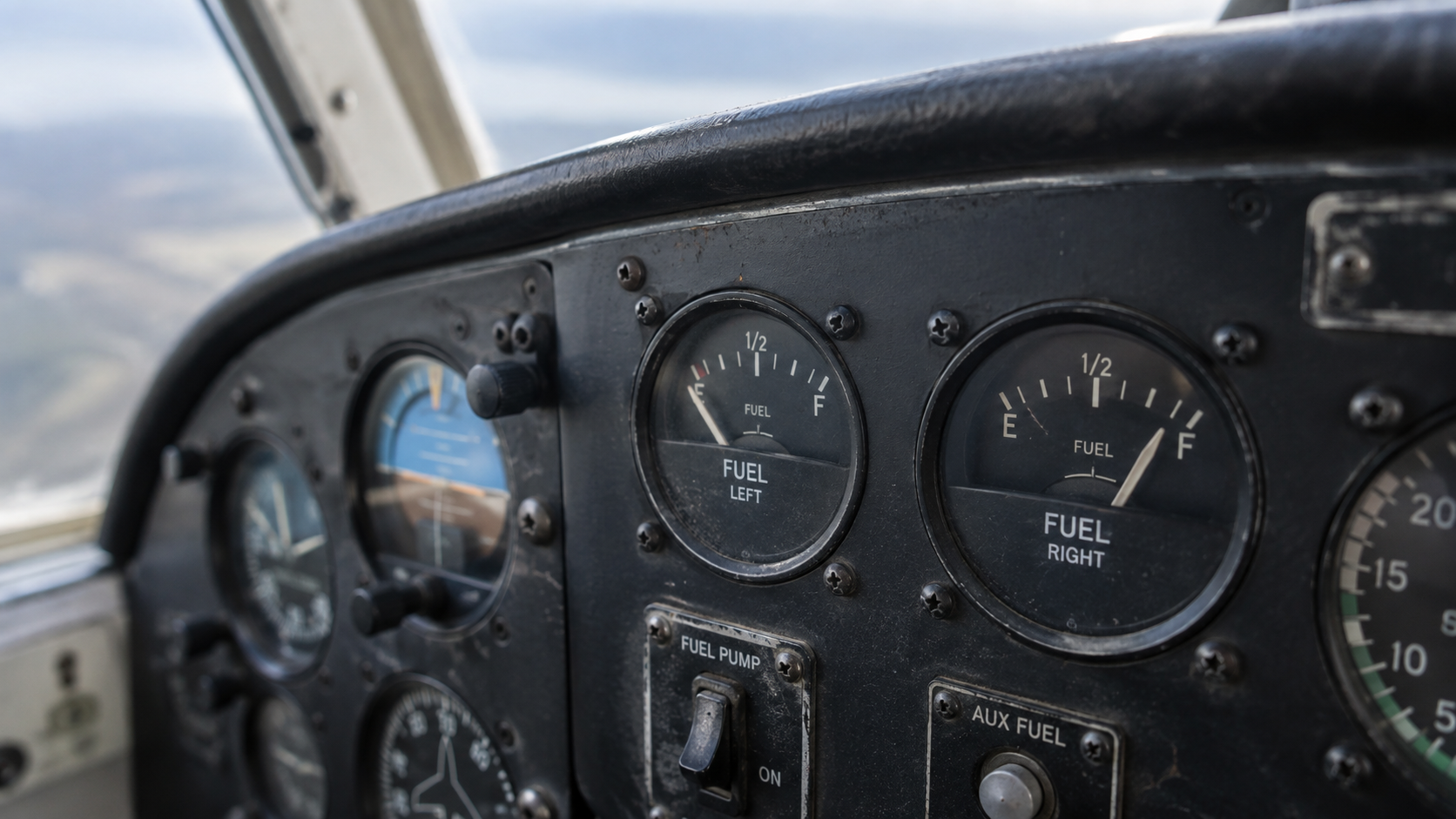
Here's a sentence every pilot has heard in ground school and quietly ignored in practice: fuel gauges are only required to be accurate when the tank reads empty. Everything above that is a rough suggestion, not a promise. Treating the needle as a real-time fuel computer is the first mistake, and it's one nearly every pilot makes at some point because the gauge is right there, staring at you, looking authoritative.
The actual plan was always supposed to be time and burn rate: known fuel on board, known consumption, known flight time, with a reserve that isn't up for negotiation. That's not advanced math. It's arithmetic you did in ground school and then, somewhere around your two hundredth flight, quietly stopped doing because the gauge "looked fine."
"I've Made This Flight Before" Is Doing a Lot of Load-Bearing Work
Familiarity is where fuel planning actually goes to die. The first time you fly a route, you plan it properly — fuel stops, reserves, alternates, the whole exercise. The fiftieth time, you've internalized "this flight takes about this much gas," and that mental shortcut is exactly right until the day it isn't: a headwind you didn't check, a hold you didn't expect, a diversion around weather that added twenty minutes nobody budgeted for.
The math didn't get harder. You just stopped doing it, because experience quietly convinced you that you already knew the answer. That's not a beginner's mistake. That's an experienced pilot's mistake, which is exactly why fuel exhaustion accidents skew toward pilots who've made the flight dozens of times before, not student pilots on their first solo cross-country.
Fuel Starvation vs. Fuel Exhaustion: They're Not the Same Failure
Worth separating these two, because they get lumped together constantly and they're not the same mistake. Fuel exhaustion is what this whole article is about: there's genuinely no usable fuel left on board. Fuel starvation is different and arguably more embarrassing — there's plenty of fuel in the tanks, but it isn't reaching the engine, usually because of a fuel selector left on the wrong tank, a mismanaged imbalance, or a system the pilot didn't fully understand.
Exhaustion is a planning failure. Starvation is a systems-knowledge failure. Both end the same way, which is exactly why "know your burn rate" and "know your fuel system" are two separate checklist items, not one.
The Reserve Isn't a Suggestion, It's the Whole Point
VFR day minimum reserve is 30 minutes at normal cruise. VFR night and IFR bump that to 45. Those numbers aren't a regulatory floor you're supposed to plan toward — they're the number you're supposed to have left after everything else went as planned, which it usually doesn't. Planning a flight that lands with exactly your legal reserve, on a good day, with no headwind and no traffic delay, isn't cutting it close. It's planning to violate the reserve the moment anything ordinary happens, because something ordinary always happens.
If your fuel plan only works when nothing goes wrong, it isn't a fuel plan. It's a bet, and the house — physics — always wins that bet eventually.
What Actually Prevents This
The fix isn't more anxiety about fuel. It's a habit: know your actual burn rate for your airplane, not the number from the POH under ideal conditions, but your real number from your logbook. Calculate a hard bingo fuel — the point where you land now, no more options, no more "let's just check one more thing" — before you take off, not somewhere over the destination when the math suddenly feels urgent. And treat any deviation from plan, any hold, any reroute, any longer taxi, as an automatic re-check of that number instead of an afterthought.
None of that requires new equipment or new regulations. It requires treating the arithmetic as seriously at hour two thousand as you did at hour twenty. If you want a structured way to build this habit before your next checkride, it is exactly what we cover inside the Free Preview Course.
The Part Worth Remembering
Every fuel exhaustion accident report reads the same way in hindsight: the pilot had the information, did the math wrong or not at all, and trusted a gauge that was never designed to be trusted that way, instead of the bingo fuel number sitting in their own preflight math. It's the most preventable category of accident in aviation, which is exactly why it keeps happening — preventable things get complacent about, right up until they don't.