You already know how to fly a lazy eight. You've known since your commercial checkride. So when CFI applicants end up in a checkride failure over the maneuvers section of their initial ride, it's rarely because they forgot how to fly. It's because they flew it instead of teaching it.
That distinction sounds small until you're the one standing on the ramp, demonstrating a maneuver silently while your DPE waits for the explanation that never comes. It's an uncomfortable silence, and it's the moment that decides how the rest of the ride goes.
The CFI checkride isn't retesting your stick and rudder skills. It's testing whether you can put someone else's hands on the controls and get them to a standard, safely, while narrating why every input matters. That's a completely different skill, and most applicants prep for the wrong one.
The Applicant Who Flies It Instead of Teaching It
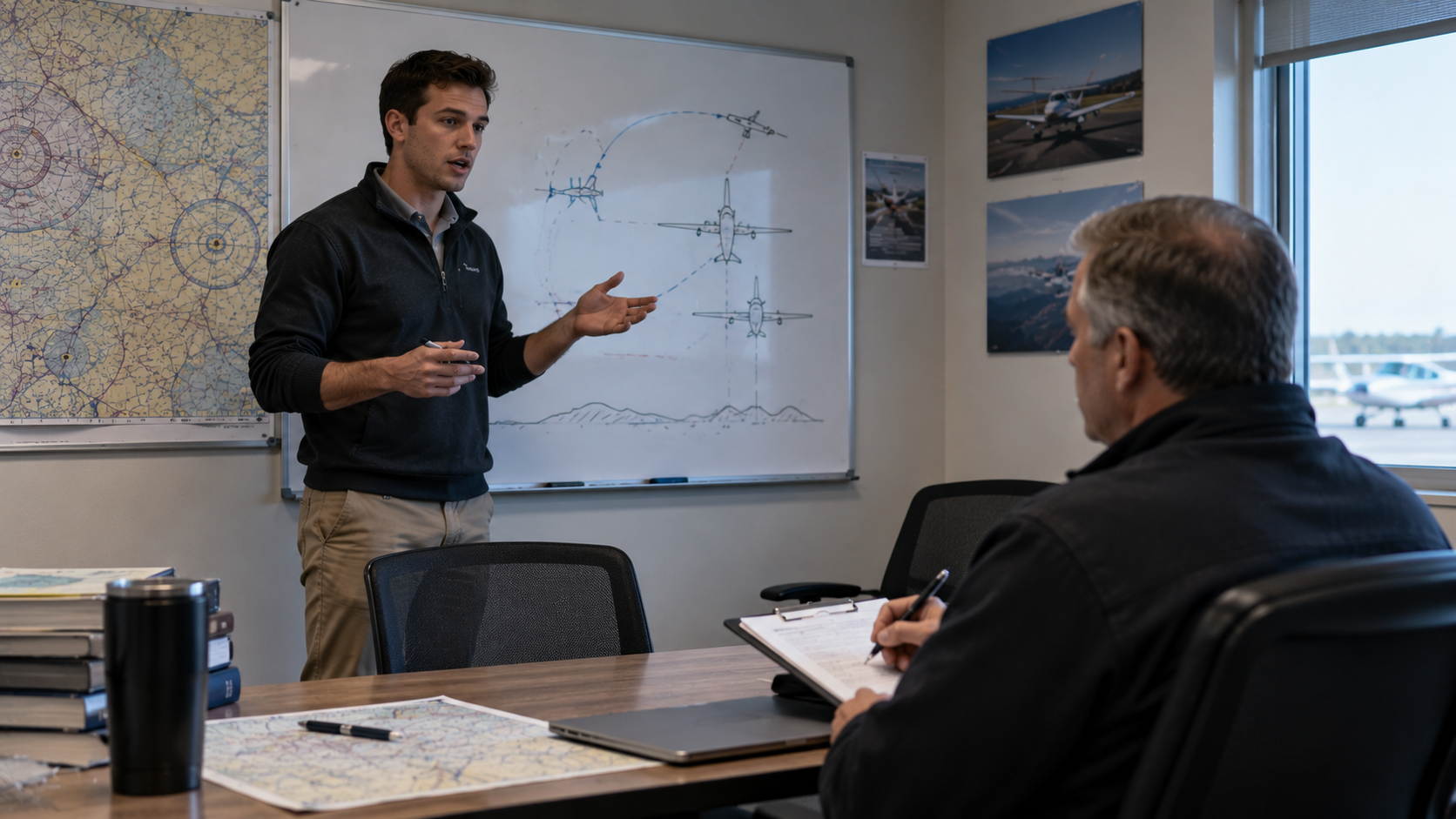
Here's the pattern examiners see constantly. An applicant demonstrates a maneuver flawlessly and silently, the way they've done it a hundred times as a pilot. Then the DPE asks them to talk through it as if a student were in the right seat, and the wheels come off. Suddenly they're explaining adverse yaw with the confidence of someone who's never had to say it out loud before.
That's not a knowledge gap. It's a rehearsal gap. You can know something perfectly and still be terrible at teaching it on the first try, because teaching is its own skill with its own muscle memory. The Flight Instructor Airman Certification Standards make this explicit: the CFI applicant is being evaluated on the fundamentals of instructing and the ability to apply them to specific maneuvers, not just on their own proficiency at flying those maneuvers.
The Lesson Plan Trap Behind Most Checkride Failures
The second place applicants end up in a checkride failure isn't the flying, it's the lesson plan itself. A DPE can tell within thirty seconds whether a lesson plan was built to actually teach with, or built the night before specifically to survive the checkride.
The tell is always the same. A real lesson plan anticipates where a student gets confused and has a specific way to correct it. A checkride-only lesson plan just restates the maneuver description from the Airplane Flying Handbook in slightly different words and hopes nobody asks a follow-up question. DPEs ask follow-up questions. That's the job. A lesson plan library built ahead of time heads off most of this before it ever becomes a problem on checkride day.
Why "I Know It Cold" Isn't the Same as "I Can Teach It Cold"
There's a specific overconfidence that trips up strong pilots on their CFI ride. They've flown steep turns a thousand times, so they assume the teaching part will just come naturally in the moment. Sometimes it does. Often it doesn't, because narrating a maneuver in real time while also flying it and also watching for a hypothetical student's hypothetical mistakes is a genuinely different cognitive load than just flying it well.
The applicants who pass calm have usually rehearsed the teach-it-out-loud version dozens of times before the checkride, not just flown the maneuver dozens of times. Those are not the same rep.
What Actually Closes the Gap
Closing the gap between knowing a maneuver and teaching a maneuver takes three specific things.
Rehearse the Explanation Out Loud
It takes rehearsing the verbal explanation out loud, not just in your head, because your head will let you skip the awkward parts. A checkride failure often traces back to an applicant who never said the explanation out loud until the DPE was sitting across from them.
Anticipate Specific Student Errors
It takes anticipating specific student errors for each maneuver, not just the maneuver's correct execution, because that's what the DPE is actually going to probe. Walk through the three or four ways a student typically gets it wrong before you walk through the maneuver itself.
Build a Lesson Plan That Holds Up
And it takes a lesson plan structure that holds up under a follow-up question, not one built to survive a single read-through. That structure is what separates a checkride failure from a checkride that goes the way an applicant expected.
None of that is about flying better. It's about preparing for a different test than the one most applicants think they're taking.
Where This Leaves You
You're not walking into your CFI checkride to prove you can fly. You already proved that on your commercial ride. You're walking in to prove you can take someone else from confused to competent, safely, while explaining every step along the way. Prep for that specific skill and the maneuvers stop being the hard part.
That's exactly the gap CFI Bootcamp's CFI Training Package is built to close, with lesson plans and maneuver breakdowns built around how the checkride is actually scored, not just what the maneuver looks like on paper.
References
FAA Flight Instructor Airman Certification Standards (FAA-S-ACS-25) — https://www.faa.gov/training_testing/testing/acs