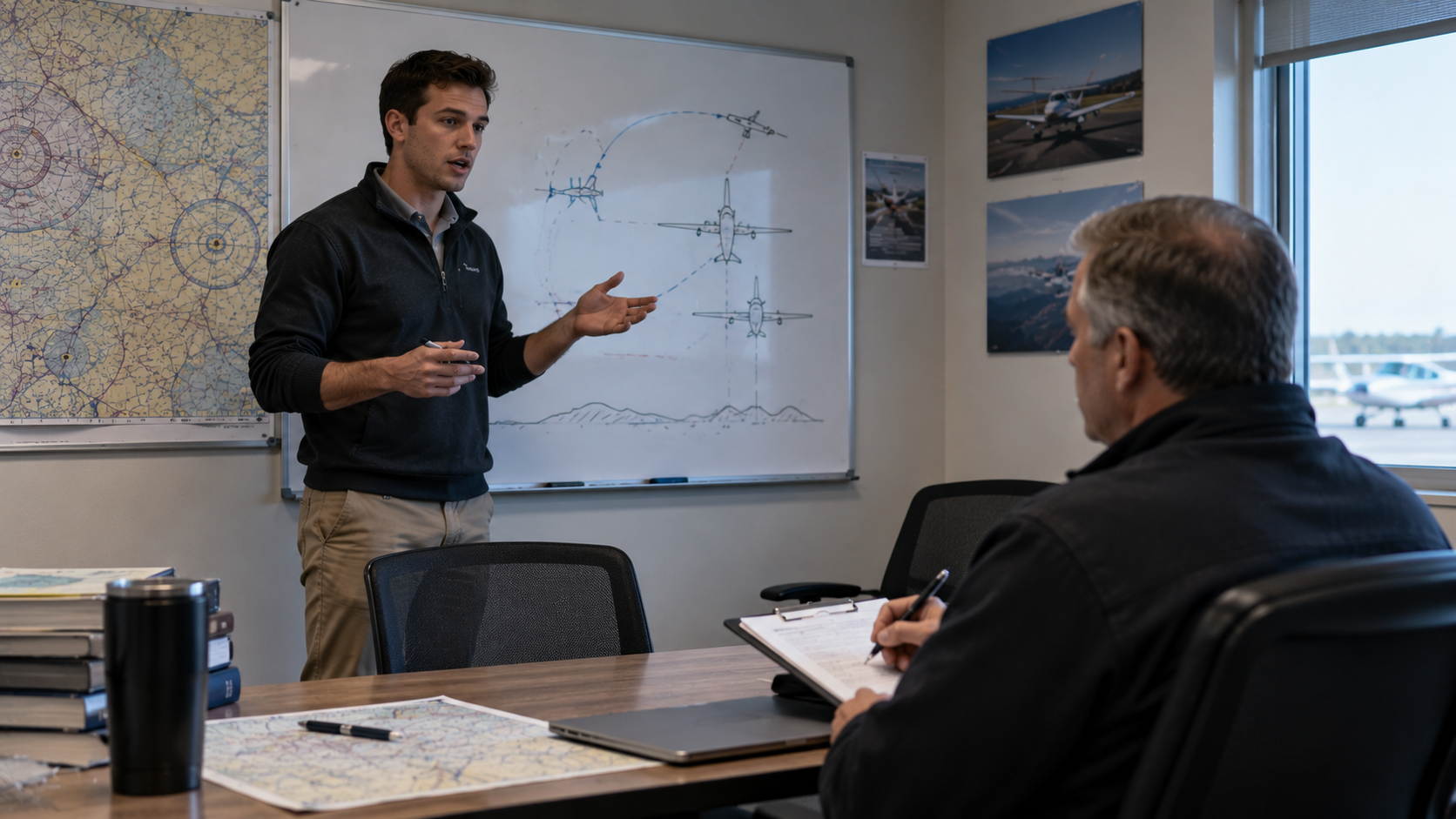
There's a version of the CFI applicant who shows up to the checkride flying beautifully. Lazy eights inside 50 feet. Chandelles that look like they came out of the Airplane Flying Handbook. Then the examiner asks him to teach turning tendency to a pretend student, and he says "so basically the propeller pulls it left," draws something on a napkin, and stops talking.
That checkride is in trouble. Not because he can't fly. Because the student's understanding of the CFI technical subject areas are lacking — it's can you do it and explain it at the same time, to someone who has never seen it before.
Open FAA-S-ACS-25 and read the actual wording under Area of Operation II. The applicant demonstrates instructional knowledge by describing and explaining. The applicant explains and teaches how to identify and manage risk. The applicant demonstrates and simultaneously explains how to perform. That phrase — demonstrates and simultaneously explains — shows up over and over, and it is the entire difference between your commercial checkride and this one.
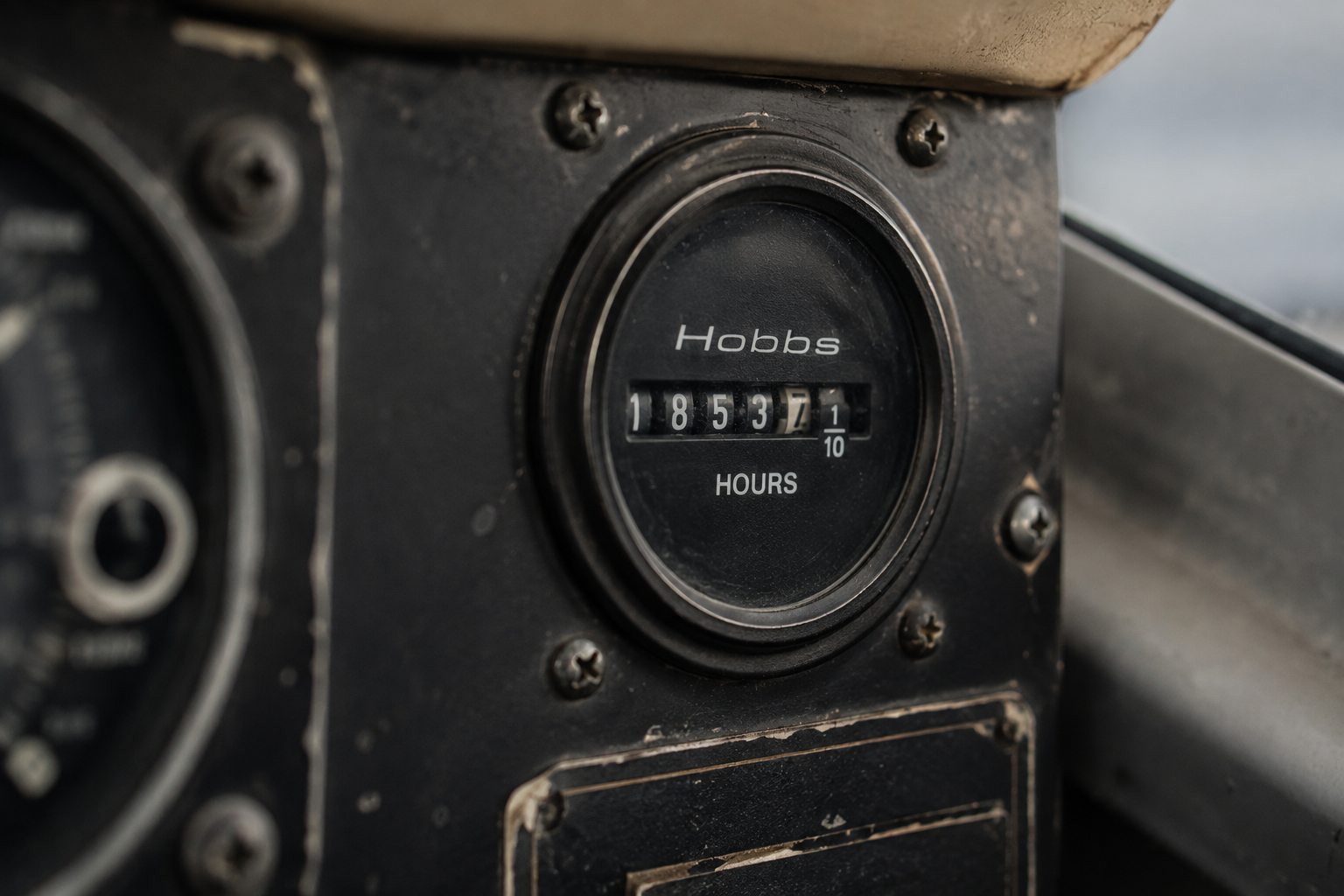
So here's the argument. The first step of finishing your CFI isn't scheduling right-seat time. It's owning Area of Operation II cold, on the ground, before you start paying Hobbs rates to learn it out loud.
Two CFI Technical Subject Areas Task Are Mandatory on Every Initial Checkride
Most applicants don't know this, and it's printed in the note at the top of Area of Operation II.
The evaluator must select Task C, Runway Incursion Avoidance, and Task K, Endorsements and Logbook Entries, plus at least one other task from that area. Multiengine applicants also get Task P, One Engine Inoperative Performance. It isn't a lottery. Two of those tasks are coming, guaranteed, on every initial flight instructor practical test.
Read that again if you're the kind of applicant who has been quietly hoping the examiner picks something you like.
Endorsements in particular deserve more respect than they usually get. The ACS asks you to describe and prepare logbook entries and endorsements for at least two of the listed events — pre-solo knowledge test and solo endorsements, other required logbook endorsements, practical test recommendations, flight review endorsements. It also asks about flight instructor records and your own renewal and reinstatement requirements. This is the paperwork that defines whether you're a legal instructor, and it's guaranteed to be on the test.
What's Actually in Area of Operation II
The CFI technical subject areas are broader than most applicants assume, and knowing the actual list matters when you're building a study plan.
Area of Operation II covers: Human Factors, Visual Scanning and Collision Avoidance, Runway Incursion Avoidance, Principles of Flight, Aircraft Flight Controls and Operation of Systems, Performance and Limitations, the National Airspace System, Navigation Systems and Radar Services, Navigation and Cross-Country Flight Planning, 14 CFR and Publications, Endorsements and Logbook Entries, Night Operations, and both High Altitude Operations tasks — supplemental oxygen and pressurization. Seaplane applicants add water and seaplane characteristics. Multiengine applicants add OEI performance.
Two things people commonly get wrong about that list:
Weather isn't on it. Weather Information is Task C under Area of Operation III, Preflight Preparation. It's absolutely coming — the evaluator must select at least one task from that area — but if you're building a study plan around "the technical subjects," don't file weather in the wrong drawer.
Weight and balance isn't its own task. It lives inside Task F, Performance and Limitations, alongside performance charts, factors affecting performance, and methods for computing CG. Same material, different address.
The Standard Is Three Things, Not One
Every task in the ACS is built on three columns: knowledge, risk management, and skills. Applicants prepare for the first one and get ambushed by the second.
Take Principles of Flight. The knowledge elements are airfoil design characteristics, stability and controllability, turning tendency, the forces acting on an airplane, load factors in design, and wingtip vortices. Fine. Most commercial pilots can talk through those.
Then the risk management column asks you to explain and teach how to identify and manage risk associated with the basic aerodynamic principles of flight. And the skills column asks you to deliver instruction on at least three of those elements.
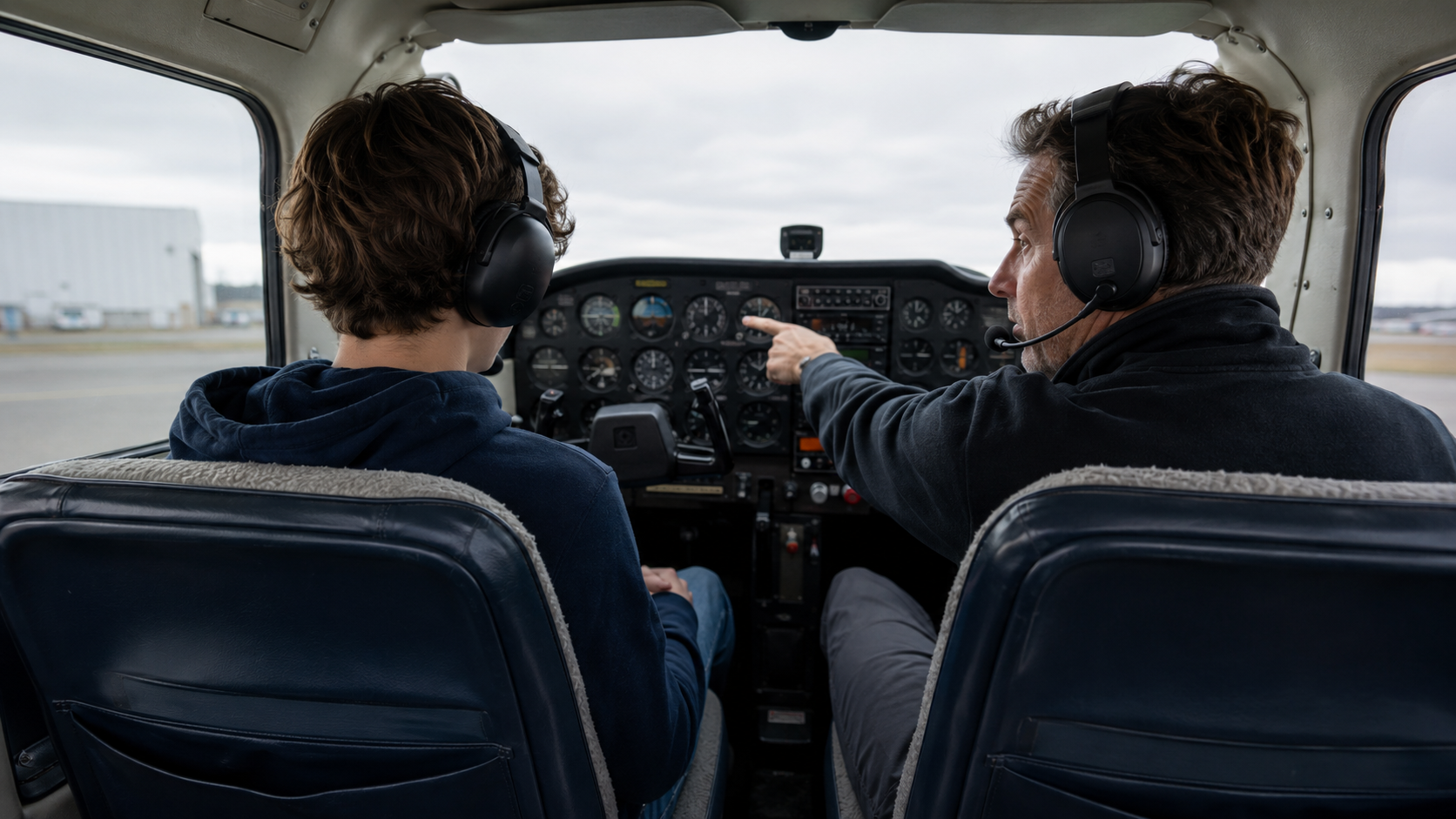
Explain and teach how to manage risk. Not recite. Not define. Teach. That's a fundamentally different preparation, and you can't build it from a handbook you're skimming between flights.
"I'll Pick It Up While I Fly" Is the Most Expensive Plan Available
The standard approach: find a CFI, start flying from the right seat, study on the side, build the lesson plans as you go.
And look, that works. Mostly. Until you're 20 hours in, paying instructor and aircraft rates, and using the most expensive classroom in America to have a conversation about CG computation that you could have had for free on your couch.
The problem isn't effort. It's sequencing. You cannot demonstrate and simultaneously explain something you haven't organized in your own head on the ground first. Right-seat flying is difficult enough without assembling your technical foundation mid-maneuver, out loud, while flying.
The applicants who move fastest are almost never the best sticks. They're the ones who arrived already fluent, so every airplane hour went to what airplane hours are actually for.
What the 100% Online ACS CFI Course Does About It
CFI Bootcamp's 100% Online ACS CFI Course exists for exactly this phase — the part before you're any good at teaching yet, when what you need is complete, structured coverage built against the current standard.
It's over 40 hours of high-definition video, self-paced, split into roughly 14 hours of academic ground school and 30 hours of practical instruction, covering the cfi technical subject areas taught by an experienced FAA and UK CAA Pilot Examiner. That last detail matters more than it sounds like it does. This is content built by someone who has sat on the other side of the table and knows which explanations hold up under questioning and which ones fall apart at the follow-up.
Three things it does that studying alone does not:
It's built against FAA-S-ACS-25, not the old PTS. The current ACS was published in November 2023 and superseded FAA-S-8081-6D, the 2012 Flight Instructor PTS. Plenty of study material floating around still reflects the old document. Structure and emphasis changed.
It checks whether you actually got it. Quizzes and assessments are embedded throughout the curriculum, not bolted on at the end. Reading a chapter and believing you understand it is not the same as being asked and finding out.
It comes with the resources. Custom curated lesson plans, self-study guides, CFI Essentials, and audio files for the drive to the airport — material you'll keep using as a working instructor, not just to pass a checkride.
Most applicants spend two to three weeks working through it properly. That isn't a shortcut. That's the design.
Less Time On Campus Is the Entire Point
The course exists to bring you up to speed quickly and cut down the total on-campus time required to finish your certificate. Sit with that for a second.
Ground school and flight training are the two most expensive resources in this process. Every hour you spend in either one covering material you could have learned self-paced at home is an hour you paid a premium for.
Show up to a 7-day ground school already fluent in Area of Operation II and that week stops being remedial. It becomes scenario work, teaching delivery, lesson plan critique, and oral prep under examiner-level scrutiny.
Show up cold and you'll spend the first three days relearning airspace.
The Math Nobody Runs Before They Start
Price out the alternative. Fifteen extra hours of aircraft and instructor time spent on ground material you could have covered at home. At current wet rates plus instructor fees, that's several thousand dollars.
Then add what a failed oral costs. Retest fee, second examiner appointment, scheduling delay, and a discontinuance that follows you into every airline application you'll ever submit. Recruiter data is fairly consistent — a couple of failures is survivable at most regionals, three is where the conversation ends.
The ground course is the cheapest insurance in the process. It's also the only part of CFI training you can complete at midnight, in a t-shirt, from your phone.
Start Here: 100% Online ACS CFI Course — $900
For a limited time, the complete 100% Online ACS CFI Course is $900 instead of the standard $1,200.
What's included:
Over 40 hours of HD video — approximately 14 hours of academic ground school plus 30 hours of practical instruction
Coverage built for the current ACS, including the Fundamentals of Instructing and the Area of Operation II technical subject areas
Custom curated lesson plans and self-study guides you'll keep using as a working CFI
Embedded quizzes and assessments throughout the curriculum
CFI Essentials and audio files included
Self-paced and mobile-friendly — any device, anywhere
Use it on its own, alongside your current CFI or flight school, or as the prerequisite before a 7-day scenario-driven ground school in Palo Alto or Miami Beach.
Claim the $900 course
Want to see it first? Preview the course
(Questions? info@cfibootcamp.com or 650-600-1021.)