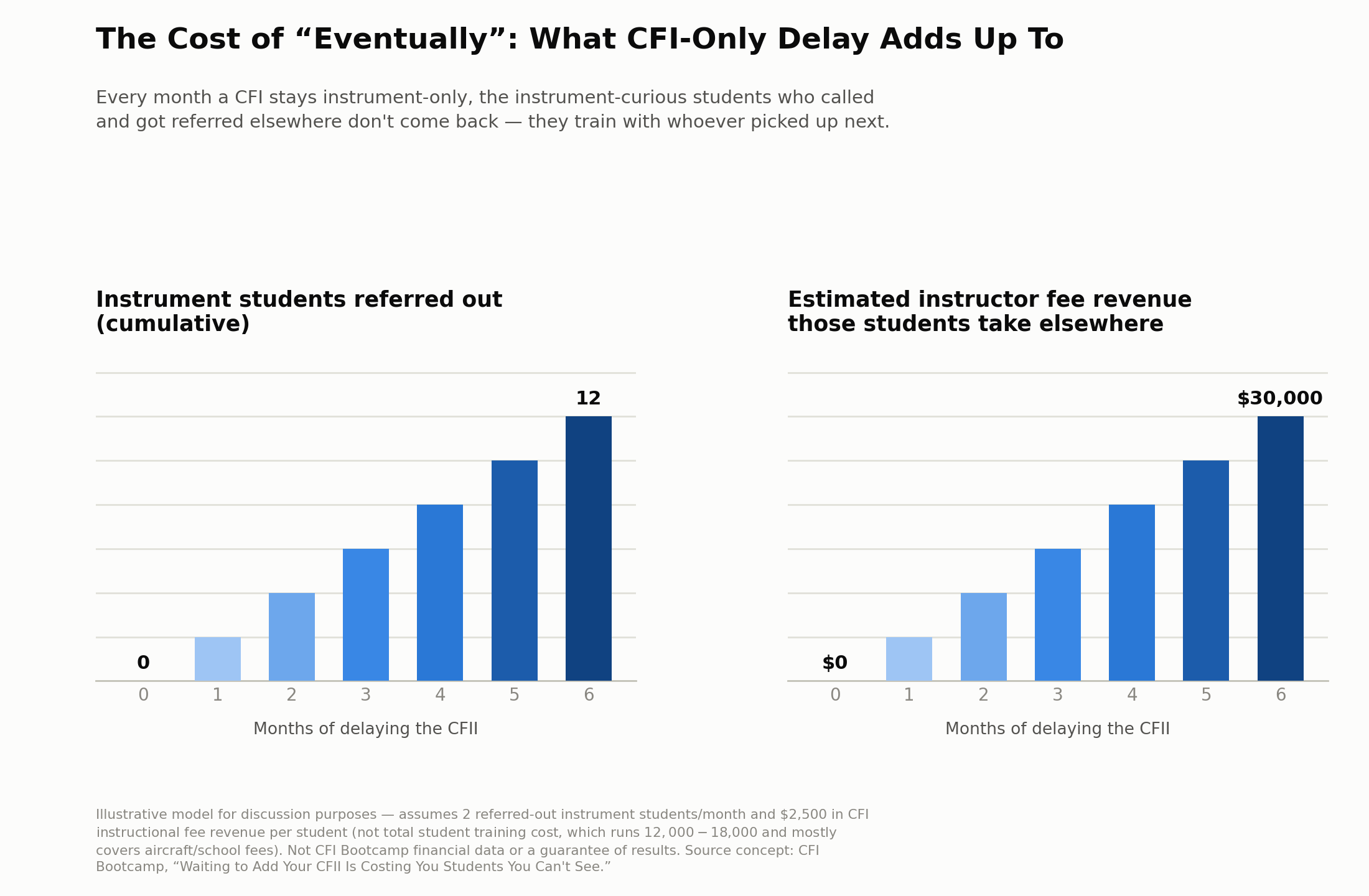
Somewhere this month, a private pilot at your airport decided it's finally time to start instrument training. They asked around, got your name, and called you. You told them you're CFI only, gave them another instructor's number, and went back to your Tuesday. That's the CFI to CFII gap playing out in real time, and it happens at training airports every week without most instructors ever hearing about the ones that got away.
That student didn't wait for you to get your CFII. They just started training with whoever picked up next. And the next student who asks around your airport is going to hear that name instead of yours.
That's the part of the CFI to CFII timeline nobody puts a number on. It's not a missed rating. It's a slowly shrinking list of people who used to think of you first.

"Eventually" Is Doing a Lot of Work in That Sentence
Almost every new CFI plans to add the instrument rating eventually. Eventually is a comfortable word because it never actually arrives on its own. There's always a reason it makes more sense in six months: build more dual-given hours first, save up for the additional training, wait until things settle down.
Six months later, the same reasons are still there, just with different specifics. Meanwhile, every instrument-curious private pilot who called your airport during that stretch trained with somebody else, and most of them aren't calling back to switch instructors halfway through their rating.
What CFI-Only Actually Caps
Being CFI-only doesn't just limit which certificates you can sign off. It limits which students see you as their instructor at all. A private pilot who's about to start instrument training isn't thinking about your primary training reputation. They're thinking about who can take them all the way through the rating without a handoff in the middle. That's the quiet cost of staying CFI-only longer than you planned to.
FAA civil airman statistics have consistently shown pilot certificate issuances trending upward year over year, which means the instrument student pipeline isn't shrinking. It's the instructors who can only take students partway through their training plan who end up capped, not the demand itself.
Think about what that handoff actually costs you. You did the work of building trust during primary training. You taught them to fly, answered their early questions, and became the instructor they trust at the airport. Then, the moment they're ready for the next step, you hand all of that off to someone else, and that person gets the credit, the referral, and the long-term relationship you built the foundation for.
The Compounding Problem With Waiting on Your CFI to CFII Move
Here's the part that makes waiting more expensive than it looks.
You're Not Building CFII Teaching Reps Either
Every month you're CFI-only, you're also not building instrument teaching reps, which means when you finally make the CFI to CFII move, you're starting that experience clock from zero anyway.
Early Movers Compound the Advantage
The instructors who add it early aren't just capturing more students sooner. They're also building CFII-specific teaching experience earlier, which compounds into referrals and into a stronger reputation for taking students the full distance.
That Compounding Eventually Buys You Choice
Eventually it turns into the kind of demand that lets you be selective about your schedule instead of scrambling to fill it. Waiting doesn't pause that clock. It just delays when it starts.
Why CFI to CFII Timing Matters More in 2026 Than It Used To
The instructor market right now rewards CFIs who can carry a student from private pilot through instrument without a referral in the middle. Students increasingly prefer one instructor for the whole journey when that's an option, because it means less relearning, less repeated background explaining, and a training relationship that already has trust built into it.
This isn't a prediction about some future trend. It's already how instrument-curious private pilots are choosing who to call. They ask around, they hear which instructors can take them the whole way, and they book with whoever clears that bar first. The CFI to CFII decision isn't optional background planning anymore. It's a factor in whether you're even in the conversation.
An instructor who can only offer half that journey is competing on a smaller board than the one who can offer all of it.
What the Early Move Actually Looks Like
It helps to walk through what each path actually looks like in practice, not just in theory.
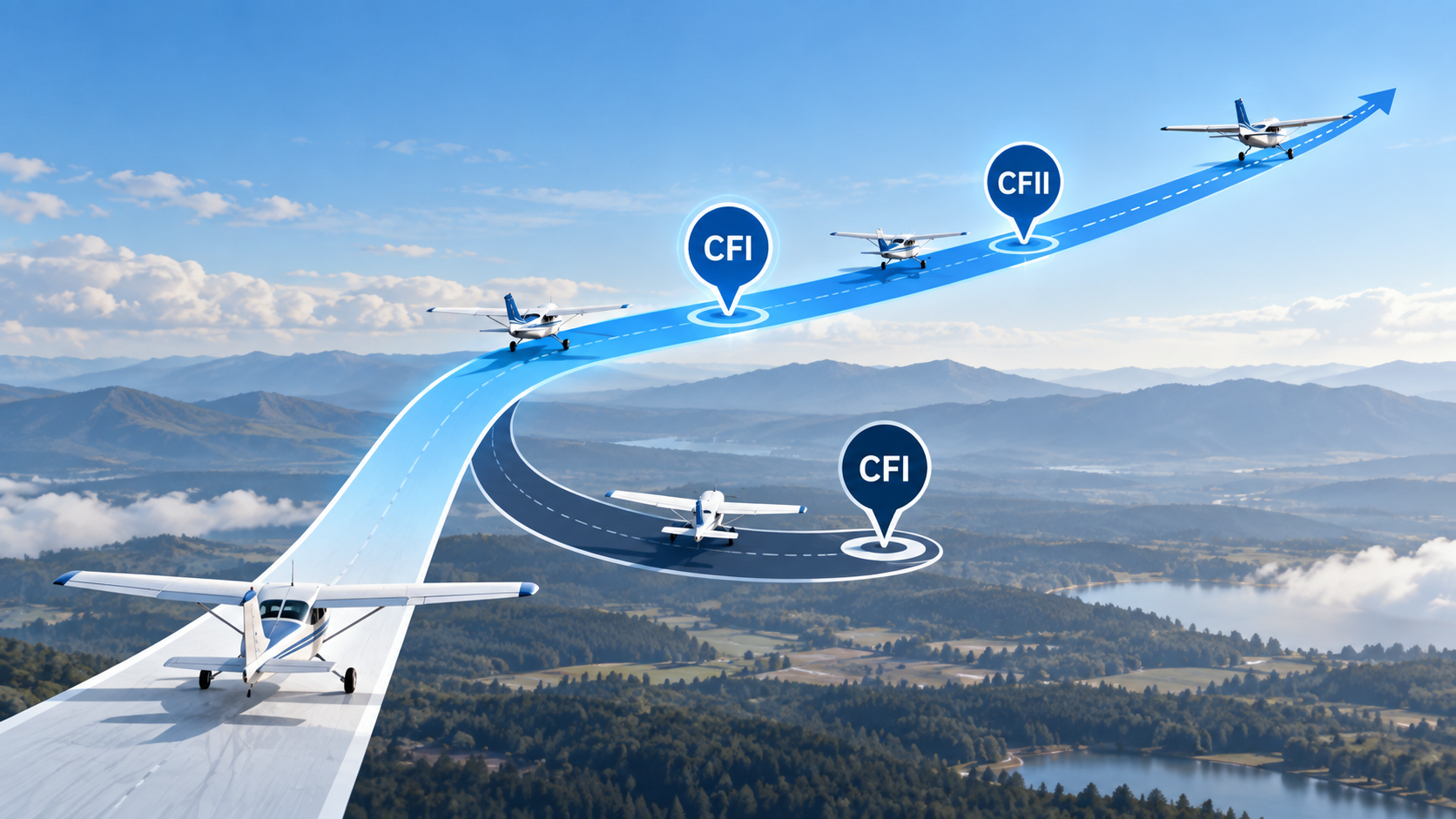
Staying CFI-Only
You keep building primary students, which is valuable work on its own. But every instrument-curious pilot who calls gets referred out, and you have no real way of bringing them back once they've started training with someone else. Your schedule stays built around one type of student, which can feel manageable right up until the slow season hits and that single lane is all you have to fill it.
Making the CFI to CFII Move
You take on the additional training, which costs time and some money up front. In exchange, you stop referring instrument-curious students out by default. You start building a second kind of teaching experience, which means your reputation starts spreading in two directions instead of one. And when a private pilot finishes training with you and immediately wants to start on their instrument rating, you're the obvious answer instead of a handoff to somebody else.
The Honest Trade-Off
This isn't a guarantee that adding the CFII instantly fills your schedule. It's a bet that being able to say yes to the full training journey puts you in more conversations than staying CFI-only does. For an instructor building a long-term practice instead of picking up occasional lessons between other work, that bet tends to pay off, and the earlier you place it, the sooner it starts compounding.
Fitting It Around Your Current Schedule
None of this requires blowing up the teaching schedule you've already built. Most instructors who add the CFII early do it the same way they built their CFI in the first place, using the open hours around the training they're already doing, the same airport, and the same students who refer other students. The difference is what that existing reputation buys once you can say yes to the whole training journey instead of half of it.
The instructors who wait usually aren't short on ability. They're short on a reason to move now instead of next quarter. The CFI to CFII timeline doesn't reward whoever flies the best. It rewards whoever stops saying "eventually" first.
Where This Leaves You
The CFII isn't a someday certificate. It's the difference between being the instructor a student outgrows and the instructor a student stays with. Every month you delay is a month of students who found someone else, and most of them aren't coming back to switch. The CFI to CFII move is what decides which one you end up being.
CFI Bootcamp's CFII Online Course and CFII Ground School exist specifically to make that CFI to CFII move an actual date on the calendar, not just a someday plan, so the next instrument-curious pilot who asks around your airport hears your name and keeps it.
References
FAA Civil Airmen Statistics — https://www.faa.gov/data_research/aviation_data_statistics/civil_airmen_statistics