You've seen the ad. Flight school bulletin board, Facebook marketplace, a laminated flyer stapled crooked to the corkboard by the vending machine, or better yet the self AI generated ChatGPT flyer. "CFI Available, $40/hr, flexible schedule, will fly weekends."
Somebody always books that guy. Then somewhere around lesson six, they show up at the FBO looking like they've aged a year and a half, asking whether it's normal that they still can't hold altitude in a turn. Thats the "Cheap flight instructor cost"
It's not that the $40/hour instructor is a bad pilot. Most of them can fly circles around a checkride. The problem is that $40/hour was never actually the price. It's the number on the sticker before the real cost shows up — later, quietly, spread across extra hours, a stalled timeline, and a checkride you weren't actually ready for.
Cheap instruction isn't a discount. It's a deferred bill with interest.
The Math That Never Gets Done
Do the actual arithmetic on that $40 rate and it stops looking like a bargain almost immediately.
A lesson isn't sixty minutes of flying. It's a preflight briefing, the flight itself, a postflight debrief, and usually some amount of time the instructor spends afterward writing up the lesson and thinking about what comes next. Call that ninety minutes of real work for a one-hour Hobbs entry. At $40 for that hour, the instructor is making something closer to $27 an hour once you account for the time actually spent on you.
That's below what a lot of these instructors could make managing a fast food shift, and it comes with a lot more liability. Nobody sustains that rate because they've found an efficient business model. They sustain it because they're building hours toward an airline application and treating instructing as a waiting room, not a career.
Which means the true cost of the $40/hour CFI was never the $40. It's what you get instead of a business.
What You're Actually Buying at That Price
Here's the part nobody says out loud at the bulletin board: the discount instructor is optimizing for flight hours in their logbook, not progress in yours.
That's not a character flaw. It's the incentive structure. An instructor stacking hours toward 1,500 wants you flying, any flying, ideally lots of it, more than they want you finishing efficiently. A slower student means more billable hours for them before they leave for the regionals. Nobody's doing this maliciously. The incentives are just pointed in a direction that isn't yours.
You also tend to get less of everything that doesn't show up on the Hobbs meter. Ground instruction gets compressed because it's not always billed the same way flight time is. Debriefs get shorter because there's another student waiting. Lesson planning gets thinner because thorough prep takes real, unpaid time, and an instructor charging $40 an hour has already priced themselves out of doing much of it.
None of this is visible in the moment. It shows up later, in the form of a student who's flown thirty hours and still doesn't have a coherent traffic pattern.
The Turnover Problem Nobody Prices In
The other disadvantage of the cheap flight instructor cost, is one you can't see coming, they leave.
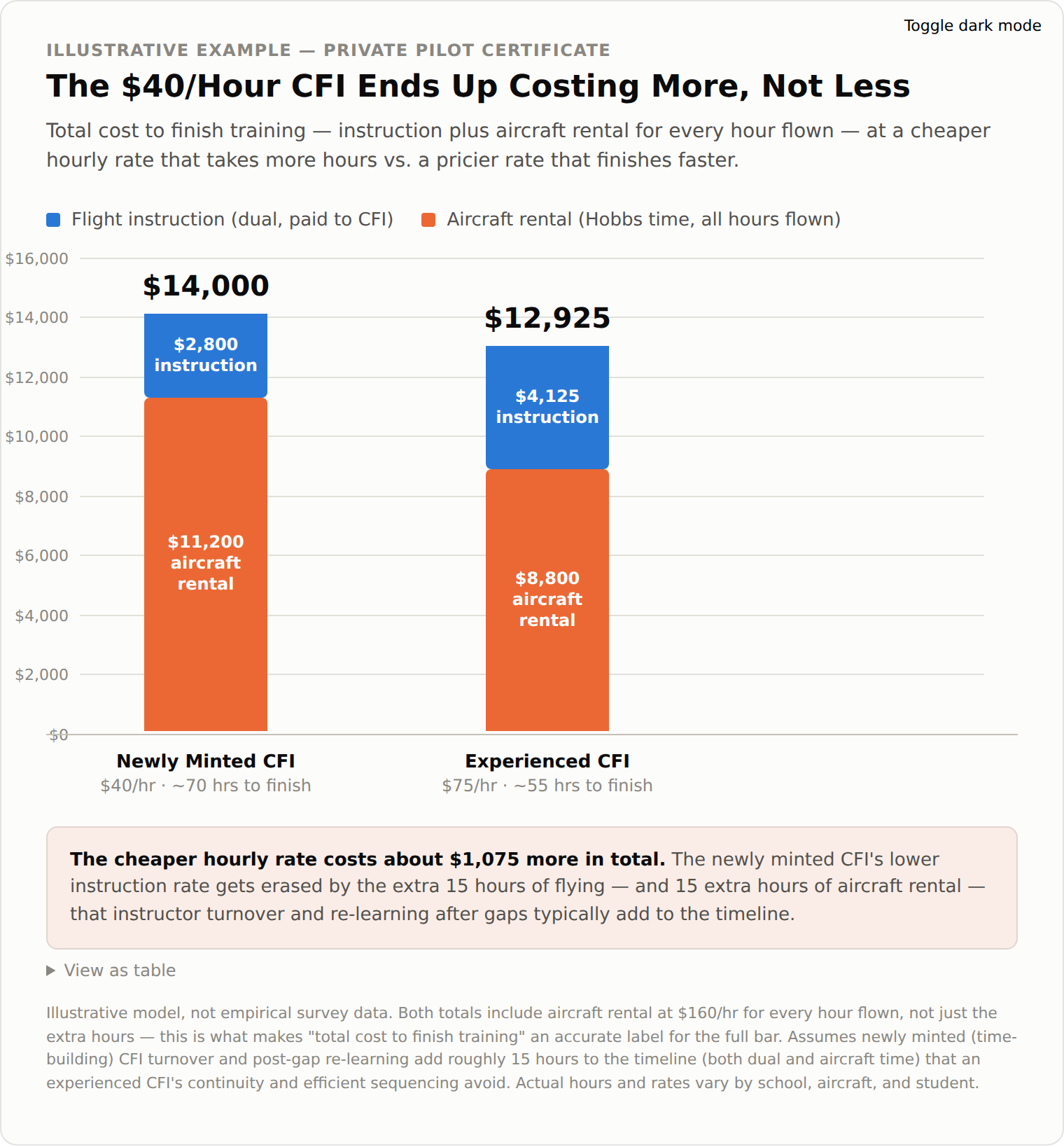
Time-building instructors are, definitionally, trying to stop instructing as fast as possible. The regional hiring pipeline has cooled from its peak, but it hasn't stopped, and the instructor who took you on in January is a real candidate to be gone by August. When that happens, you don't get a smooth handoff. You get a new instructor who has a different opinion about how you should be flying steep turns, and at least one full lesson spent renegotiating something you thought was already settled.
That's the restart tax, and it's expensive in a way that never appears on an invoice. Every instructor change costs you calendar time relearning a working relationship, re-explaining where you actually are, and re-litigating small technique disagreements that a $40/hour rate never accounted for. Do that twice in one certificate and you've paid for it many times over — just not in the column labeled "instruction."
And look — sometimes it works out fine. Plenty of people finish a certificate with a rotating cast of time-builders and never notice the difference. Most people notice. They just don't connect it back to the sticker price that got them there.
What a Properly Priced CFI Is Actually Selling You
An instructor charging a rate that reflects the real time involved, prep, ground, the flight, the debrief, ongoing availability, isn't more expensive because they're greedy. They're pricing in the fact that instructing is the job, not the waiting room before the job.
That shows up in specific, checkable ways. A properly priced CFI tends to stick around longer, because they're not purely optimizing for the fastest exit into a regional seat. They tend to run tighter ground briefings, because their rate isn't already eaten alive by the flight-only hour. They tend to have a plan for your training instead of a plan for their logbook, because your progress and their business model actually point the same direction.
None of that guarantees a good instructor. Plenty of experienced, career-focused CFIs still undercharge because they've never sat down and priced their actual time. But the incentive alignment is real, and it's worth more than the fifteen or twenty dollars an hour separating the two options.
Price Is a Signal, Not Just a Cost
The instinct to shop for the cheapest CFI comes from a reasonable place. Flight training is already expensive, and every dollar saved on the hourly rate feels like a dollar you keep.
Except it isn't a dollar saved. It's a dollar deferred into extra hours, a longer timeline, and a checkride you might not be ready for on the first attempt. The $40/hour rate isn't the discount version of good instruction. It's a different product entirely — one built around somebody else's exit plan instead of your progress.
The instructors and students who get through this efficiently are the ones who stopped treating the hourly rate as the whole decision and started asking what it's actually buying.
Join Us for This Week's CFI Bootcamp Power Hour
If the math in this article hit a nerve, here's the actual fix — not a lecture about value, an hour on where the money is.
Saturday, August 22, 2026 — 12:00 PM ET (rerun 8/26 - 8:00 PM ET) | Aviation Scholarships and Funding
More money is available than most students realize. The $40/hour instructor usually isn't a choice — it's what happens when a student assumes there's no other way to close the gap. This week's live session covers:
The scholarship categories that go underapplied every single cycle
How to talk to a financially stalled student without it sounding like a sales pitch
What separates a funded scholarship application from a rejected one
A short list of programs you can hand students today
Absolutely free. No catch. Just show up.
👉 Register here: https://cfibootcamp.kartra.com/page/Power-Hour-Lessons-Show
Bring one student who thinks the cheap instructor is their only option