What a Complete CFI Career Course Should Include?
If you want to become a certified flight instructor CFI, do not shop for a course the same way you would shop for a short checkride cram session. Those are not the same thing.
A real CFI career course should do more than help you survive the oral and practical test. It should help you become someone a school wants to hire, a teacher student pilots can trust, and a future professional pilot who can grow into bigger career paths over time.
The FAA lays out clear flight instructor eligibility, knowledge, and proficiency standards in Part 61, and the current Flight Instructor Airplane ACS remains a key standard for training and evaluation.
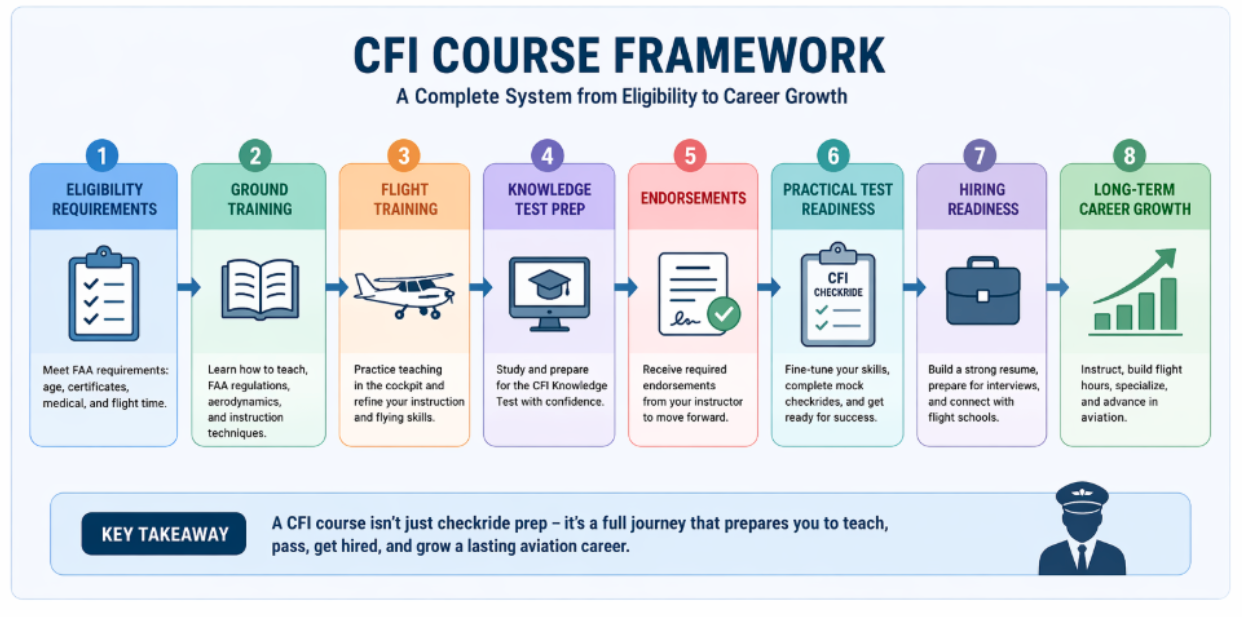
A real course starts with the full CFI foundation
A good flight instructor training program should show you the whole process, not just the final test. To begin with, it should explain the basic requirements. To illustrate, you should have reached the age of majority, which is 18 years, and be able to read, write, and speak in English. A commercial or ATP certificate in the appropriate category and class, as well as an instrument rating, is required to issue airplane instruction endorsements.
You also need ground training, flight training, knowledge test prep, endorsements, and practical test readiness. If a program skips this big picture, you will waste time and money filling gaps later.
A strong CFI Career course should also explain the difference between Parts 61 and 141, because hiring, training flow, and school expectations can differ. It should explain what the FAA expects you to know from the FOI side and from the airplane instructor side.
It should also explain where a medical certificate matters. A CFI does not always need one just to hold the certificate, but medical matters arise when the instructor acts as PIC or a required flight crewmember. That is the kind of real-world detail new instructors need early.
It must teach how to teach
This is where many weak programs fail.
A generic checkride class often teaches you what to say to an examiner. A real CFI training system teaches you how to teach. That means lesson structure, student mistakes, how to explain a topic in clear steps, how to ask better questions, how to correct errors, and how to adjust when a student does not understand the first explanation.
The FAA makes this point very clear. The Aviation Instructor’s Handbook covers the learning process, effective communication, the teaching process, assessment, planning instructional activity, instructor professionalism, and techniques of flight instruction. A complete CFI course should not treat those topics like side notes. They sit at the center of good flight instruction.
It should also use real-world scenarios. New instructors do not struggle only with aerodynamics or regulations. They struggle when a student freezes on landing, misunderstands airspace, misses a checklist item, or needs a better preflight brief.
Good courses include scenario teaching, critique practice, endorsements, logbook work, and right-seat thinking. That is the difference between memorizing and actually teaching.
CFI Bootcamp’s accelerated training page highlights scenario-driven groundwork, lesson plan use, endorsements, FOI understanding, and how to teach topics like aerodynamics, airspace, and regulations.
It should prepare you to get hired, not just get signed off
This is the biggest gap in most programs.
A real CFI prep course should help you understand what chief instructors and flight schools look for when they review a new applicant. It should cover resume basics, interview questions, teaching demos, cold outreach, and how to present your lesson plans, endorsements, knowledge, and professionalism in a way that makes sense to employers.
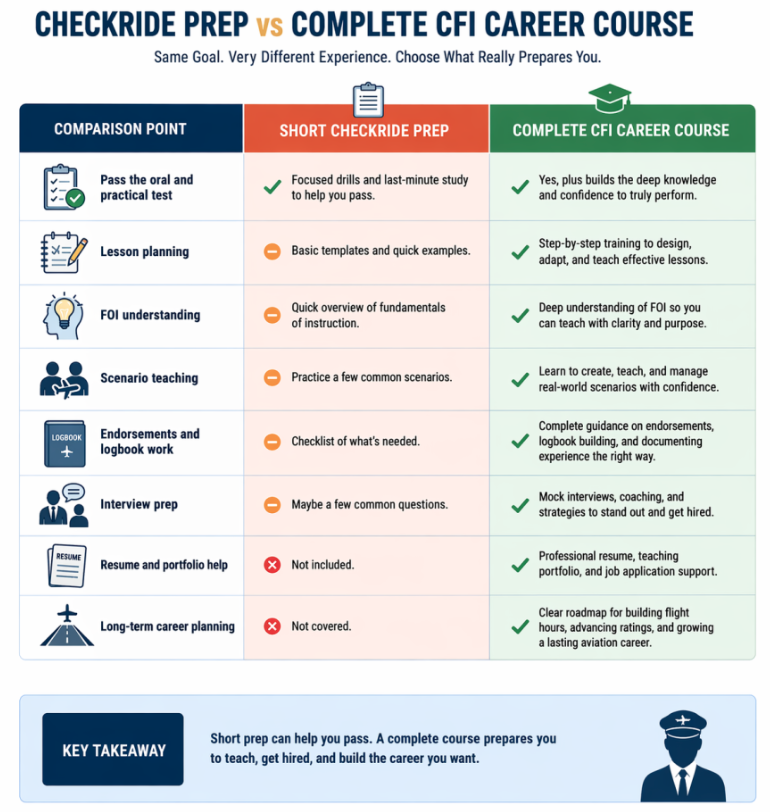
That is why a true CFI job readiness course matters. CFI Bootcamp’s prep course focuses on hiring standards, interview expectations, career positioning, outreach templates, resume help, a digital portfolio checklist, a first 90 days checklist, and a job search tracker.
It also says many new CFIs rush to the checkride and then realize they are not ready for the job search. That is a very real problem in this market.
If a course never talks about hiring readiness, it is not complete. It is only test prep.
It should support your long-term career, not just your first month
The best CFI career course helps you think past your first job.
You want a course that talks about long-term growth, more instructor ratings, stronger lesson delivery, better student retention, and the habits that build a solid reputation.
A good program should be instrumental in planning your next steps whether you stay in schooling, go to a more advanced training, or just continue to accumulate time towards your airline or corporate goals. That matters because your first instructor job often shapes your future career paths more than people expect.
This is also where CFI certifications matter. A serious course should help you see how your first CFI step connects to later growth, including CFII or MEI goals, stronger teaching systems, and cleaner professional standards from day one. That is how a new instructor starts to think like a career-minded pilot, not just a test taker.
What to look for before you buy
Always ask the direct question before paying for any program: Does this course just help me pass, or does it help me teach, work, and grow?
Good answers look like this. Scenario-based training, FAA handbook-driven teaching, self-study tools, lesson plans, assessments, scenario work, interview prep, hiring guidance, and a clear path from checkride prep to real job readiness.
Spotting warning signs early can save thousands. Avoid schools that:
Financial: Large prepayments or deposits required.
Operations: Aircraft often down for maintenance, long completion times.
Culture: Students with low morale or high turnover among CFIs.
Condition: Dirty or poorly maintained aircraft.
Pricing: Rates much lower than nearby schools (often unsustainable).
CFI Bootcamp blends a variety of activities into its online ACS course, accelerated training, and prep resources. You get 42 hours of online instruction, a self-study guide, lesson plans, assessments, and career-focused prep tools.
For a people-oriented approach to flight instructor training, look no further than CFI Bootcamp.. This flight instructor training course gets results. If you're looking to establish a solid foundation in teaching, pass with confidence, and even appear ready for the hiring side of the industry.