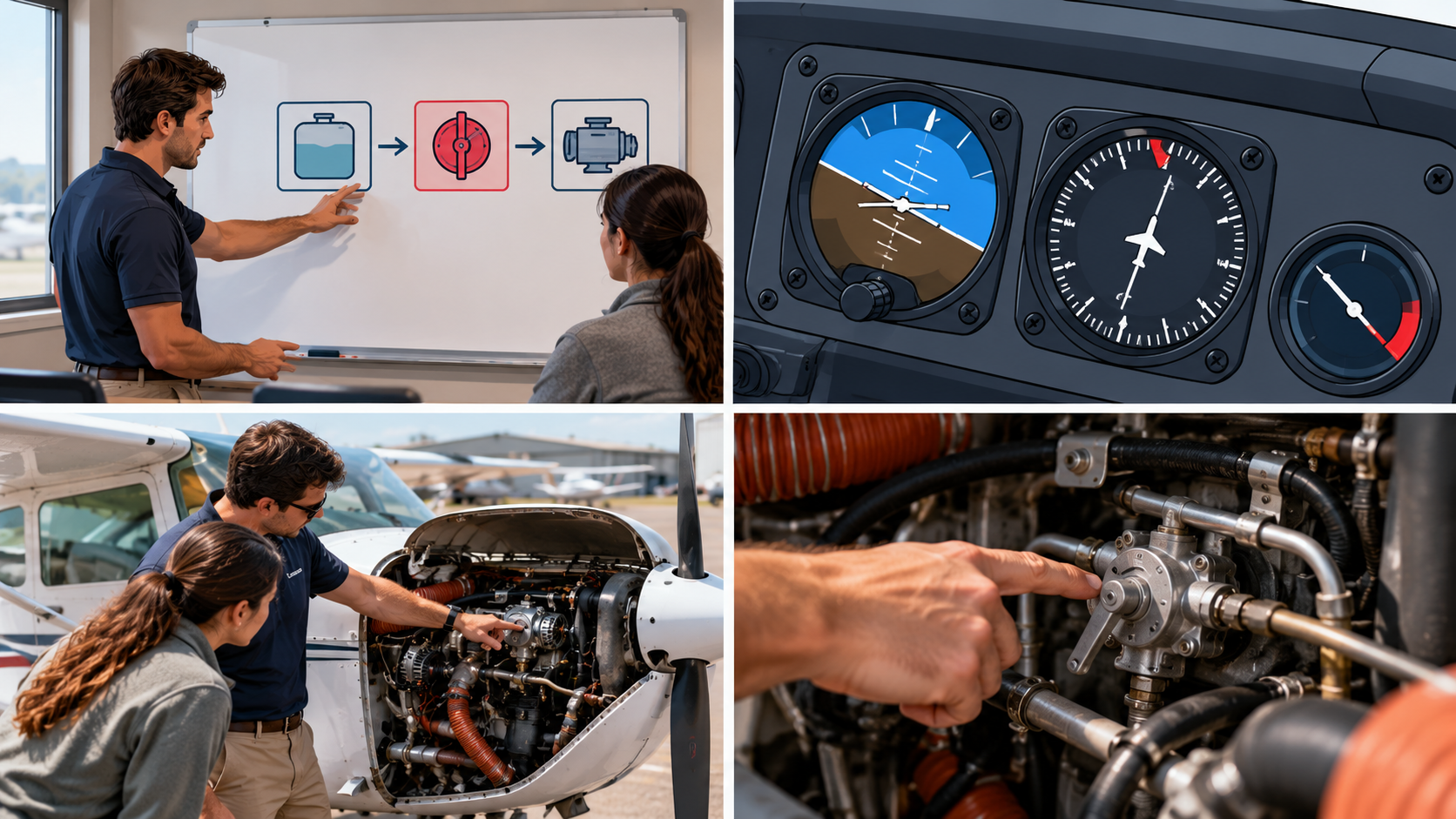
Most talk about AI lesson plans is about having software write the lesson. This is about the lesson plan you already wrote. You have one for steep turns. It has an objective, elements, a schedule, equipment, instructor actions, learner actions and completion standards. It took a weekend of your CFI training and it runs six pages.
You have never read it to a student at the airplane. Nobody has. Reading six pages aloud on the ramp is how you end up with a student who checks the weather on their phone while you talk.
So the briefing gets improvised. The student hears whatever you remember from the plan, in the order you remember it, minus the part about overbanking tendency you meant to mention.
This is the job AI lesson plans are good at. The useful version is cutting the plan you already wrote down to five minutes you can say out loud. Having a chatbot write the lesson from scratch is a different job, and a worse one.
Why the full plan never makes it to the airplane
A lesson plan and a preflight briefing do different jobs.
The plan is your reference. The FAA's Aviation Instructor's Handbook gives lesson planning its own chapter, and a good plan is thorough on purpose. It has to hold up when someone asks why you teach the maneuver the way you do. If you want a refresher on building one, start with our piece on flight instructor lesson plans.
The briefing is what the student needs in their head before engine start. What are we doing, why, how will it go, what does "good" look like, and what could hurt us today. Our rule of thumb is five minutes. Past that, the student is nodding and thinking about the radio calls.
Getting from one to the other is editing. Editing is tedious, and people skip tedious work. Software doesn't get bored. It also doesn't ask about your hours or borrow your headset, which makes it the easiest colleague at the flight school.
What AI lesson plans get wrong when you start from nothing
Type "write a lesson plan for steep turns" into a chatbot and you'll get something that looks right. Clean headings. Confident tone. Completion standards with numbers in them.
Then you read it closely. The tolerances may come from an old standard. The procedure may be for an airplane you don't fly. One of the "common errors" may be something no student has ever done.
It looks like a lesson plan the way the Cessna on a pole outside a diner looks like an airplane.
The problem is the source. A general AI tool is drawing on everything it has ever read about flying, including forum posts written by people who were wrong. It has no idea which standard is current or which airplane is yours.
So don't ask it what it knows. Hand it your documents and tell it to stay inside them.
How to build the briefing in four steps
This takes about ten minutes the first time and two or three after that.
Step 1: Give it your own lesson plan
Upload the plan you already have, or paste it in. Most current AI tools accept a PDF or a Word file.
Your plan carries your sequence, your common errors and your way of explaining things. That's what you want the briefing built from.
Step 2: Give it the standard
Download the current ACS for the certificate you're teaching from the FAA's Airman Certification Standards page and upload that too.
Don't let the tool recall the standards on its own. For private pilot steep turns, the ACS calls for approximately 45 degrees of bank, held within 5 degrees, with altitude within 100 feet, airspeed within 10 knots, and a rollout within 10 degrees of the entry heading. If your briefing says anything else, the tool went off the page.
Step 3: Ask for a briefing, with rules
Here is a prompt that works. Change the maneuver and keep the rest.
Using only the attached lesson plan and ACS, write a preflight briefing for steep turns that I can deliver out loud in five minutes. Include the objective in one sentence, the three things the learner will do, the completion standards exactly as written in the ACS with the page number, the two most common errors from my lesson plan, and the risks we will manage on this flight. Do not add anything that is not in the attached documents. If something is missing, tell me what is missing.
The last two sentences do most of the work. They turn the tool from an author into an editor, and they give it a way to say "I don't know" in place of guessing.
Step 4: Check it against the page
Read the briefing with the ACS open next to it. Every number should match. Every standard should have a page you can turn to.
This takes two minutes. Do it every time. Your signature goes in the logbook, and the software doesn't hold a certificate.
Fit the briefing into your syllabus
One briefing is a nice trick. A set of them is a system.
Run the same four steps for each lesson in a block of your syllabus and keep the format identical. Students learn the format fast. By the third flight they know where the standards are on the sheet and what you're going to ask them.
Send the one-pager the night before. A student who has read the briefing shows up with questions, and questions on the ground are cheaper than questions at 3,000 feet.
After the flight, the same sheet is your debrief. Did we meet the standards we briefed? Which of the common errors showed up? This is the fundamentals of instruction doing what they were written to do, with less typing. It's also good practice for the questions in CFI oral exam prep, where you have to explain why you teach a maneuver the way you do.
Where this goes wrong
Three mistakes account for most of the trouble we see with AI lesson plans.
Trusting the numbers. A tolerance that's close is still wrong. Check each one against the ACS, even when the tool has been right ten times in a row.
Letting brevity cut the risk section. Ask for five minutes and the tool will trim something. Make sure it didn't trim the part about traffic, terrain or the crosswind.
Expecting it to know your student. The tool doesn't know that yours gets heavy on the rudder when they're tired. Add that line yourself. It's the part of the briefing only you can write.
None of these are reasons to skip the method. They're reasons to stay the instructor.
The plan was never the problem
Your lesson plan is fine. It was written to satisfy an examiner, and your student needs the version written for them.
That version used to cost an evening per lesson, so most of us never wrote it. Now it costs ten minutes and a careful read.
The instructors who brief well aren't more talented. They walk out to the airplane with one page that says what matters.
Build these live on A.I. Day
A.I. Day is the first day of our 7-Day CFI Ground School, and it's open as a one-day class. It runs live on Zoom, with an optional classroom in Palo Alto, for $199.
One of the six sessions is this exact process, done on your own material. The day also covers:
Quizzes and study outlines built from what you're already studying
Recording and summarizing lectures
Flashcards, graphics and workbooks
PowerPoint, Zoom and ForeFlight as teaching tools

Bring an iPad or laptop and a lesson plan you'd like to fix.
See the schedule and reserve a seat at ogi-connect.com/ai-day.
Six pages is a reference. One page is a briefing.
Write the one page.
References
FAA, Aviation Instructor's Handbook, Chapter 7, Planning Instructional Activity.
FAA, Airman Certification Standards, Private Pilot for Airplane Category (FAA-S-ACS-6C), steep turns task.