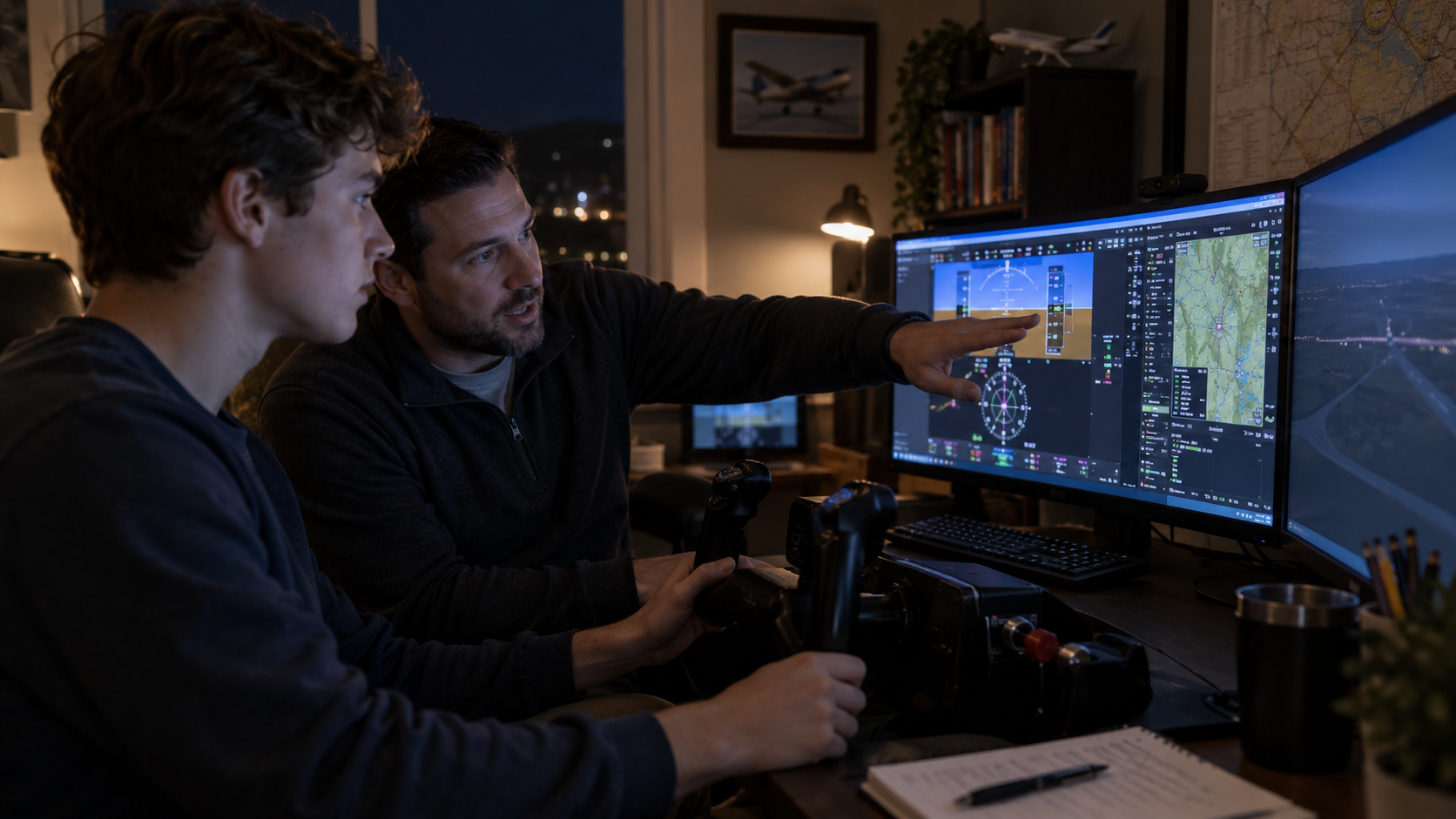
You've seen the look. Every CFI who has spent an afternoon teaching aircraft systems has seen the look.
You start explaining the vacuum system. Somewhere around "wet pump versus dry pump," your student's eyes go to the same place a 172's attitude indicator goes when that pump quits. Slowly tumbling, and nobody's cross-checking.
So you talk faster. You draw the diagram again. You mention the shuttle valve, because you're thorough. By the time you get to "and that's why the suction gauge matters," the student is nodding the way people nod at a timeshare presentation.
Then two weeks later on a stage check, someone asks what happens if the vacuum pump fails, and your student says "the engine quits?"
That's not a student problem. That's a delivery problem with teaching aircraft systems. And the fix is not more detail. It's a better order.
The parts are not the system
Most CFIs teach aircraft systems the way the POH is organized: a list of components. Alternator, battery, bus bar, circuit breakers, master switch, ammeter. Technically correct. Completely forgettable.
Here's why. A component list gives the student twenty facts and zero structure to hang them on. Every fact has to be memorized on its own. The brain does not like that, and the FAA's own Aviation Instructor's Handbook spends a whole chapter on the learning process saying essentially the same thing: people retain what they can organize, and they drop what they can't.
A mental model is the structure. It's the thing that lets a student reason about a failure they've never seen instead of reciting a definition they half remember.
So the job in teaching aircraft systems is not to transfer the parts list. It's to build the model first and let the parts attach to it.
Start with what the system is for
Before you name a single component, answer one question out loud: what problem does this system solve for the pilot?
Electrical system? It keeps the radios, lights, and flaps working, and it's completely irrelevant to whether the engine runs. That sentence alone fixes the "engine quits" answer forever.
Pitot-static? It turns air pressure into three numbers you actually fly by.
Fuel system? It gets gas from the wings to the engine without you thinking about it, until the day you have to think about it.
Say the purpose. Then stop. Let it land. A student who knows what the system is for can already make sensible decisions about it, even before they know a single part name. That's the foundation. Everything else is trim.
Build the model in three layers
Once the purpose is clear, add detail in this order and no faster. Each layer is one lesson block, not one sentence. This is the same layered approach the Fundamentals of Instruction describe for any complex skill, just applied to aircraft systems.
Layer 1: Purpose
Covered above. One sentence per system. If you can't say it in one sentence, you don't understand it well enough to teach it yet, and that's worth knowing before the student finds out for you.
Layer 2: Flow
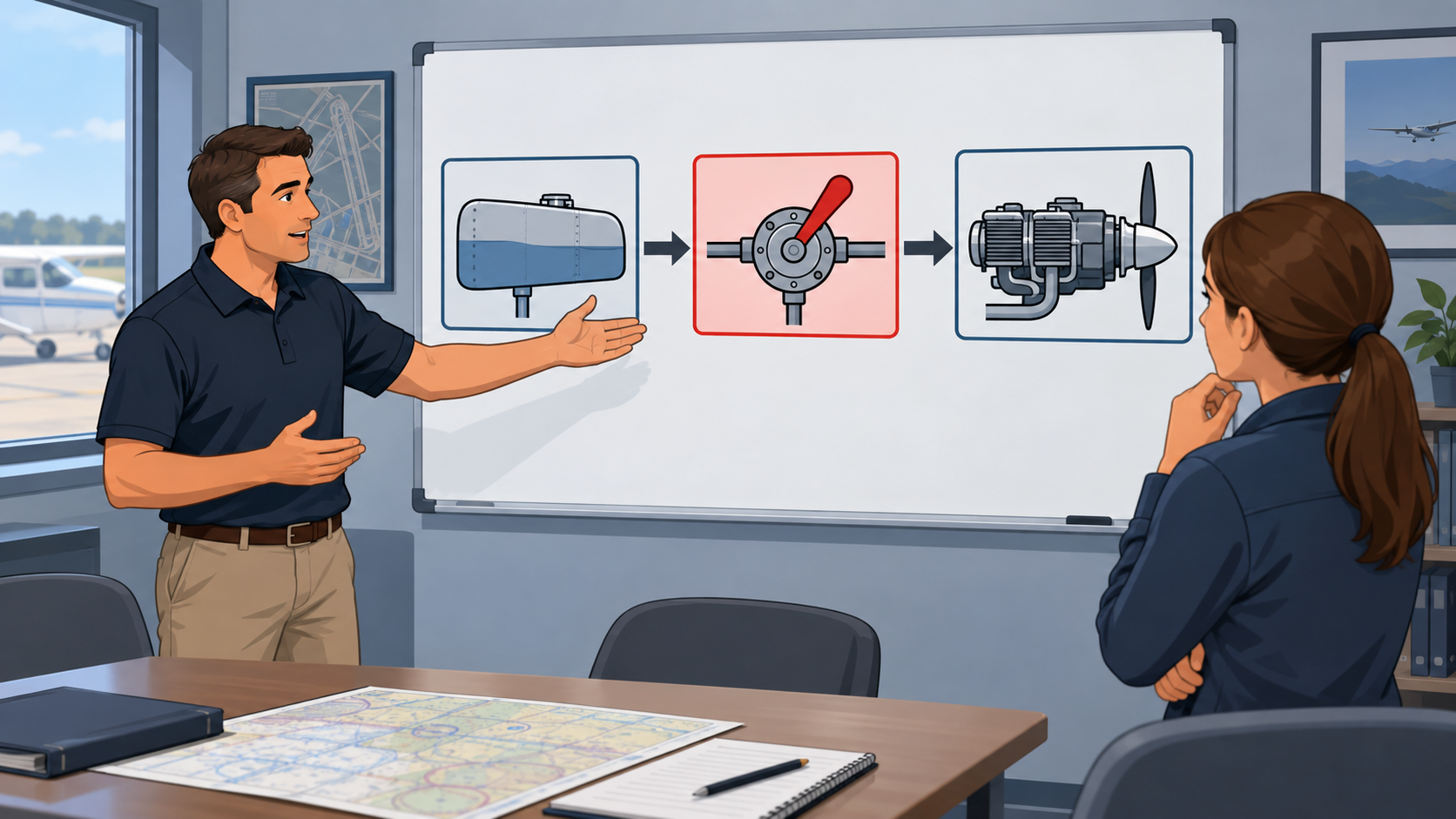
Now trace the path. Where does the energy, fluid, or air start, where does it go, and where does it end up? Fuel from the tanks, through the selector, through the strainer, to the carburetor. Electrons from the alternator, through the bus, to the loads. Air from the pitot tube to the airspeed indicator.
Draw it as a line with arrows, not as a wiring schematic. A student can hold a path in their head. They cannot hold a schematic.
Layer 3: Failure
This is where the model earns its keep. Ask: if this part fails, what stops working, and what will I see in the cockpit? Alternator dies, battery carries the load for a while, ammeter shows discharge, eventually the radios get quiet. That's a story. Stories stick.
Failure is also where you test whether the model is real. If the student can predict the symptoms of a failure you didn't explicitly cover, the model is working. If they can only recite the failures you drilled, it isn't.
Use the airplane you're actually flying
Generic systems knowledge is fine for the written. It's useless in the cockpit.
If your student flies a 172 with a fuel selector that has a BOTH position, teach that. If they fly a Piper with a left/right selector and a tank that will absolutely run dry if they forget to switch, teach that, and teach it early, because that one's a real accident category.
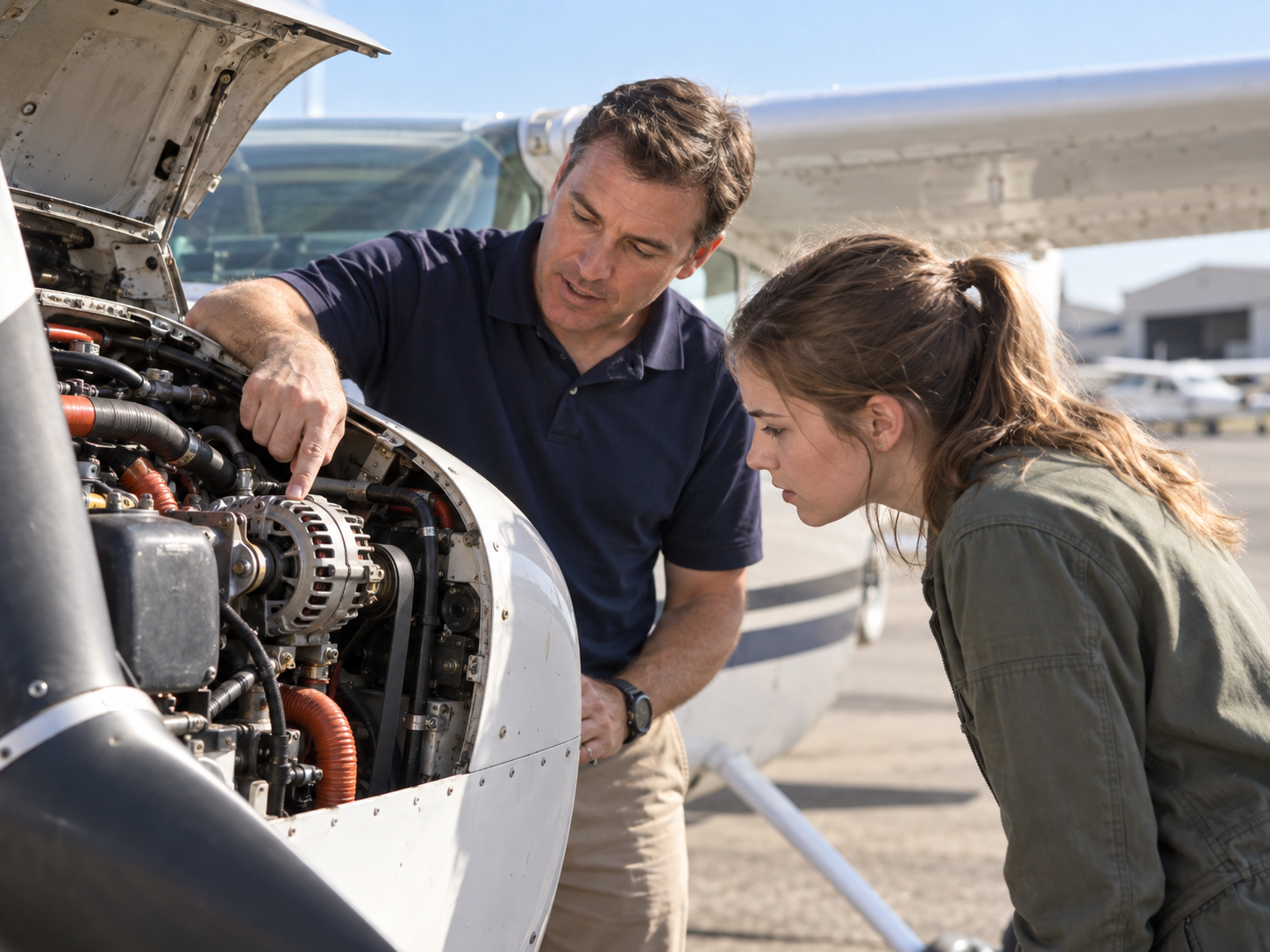
Walk out to the airplane. Open the cowling. Point at the alternator. Have the student trace the pitot line with a finger. Systems taught in a briefing room stay in the briefing room. Systems taught next to the actual pump end up in long-term memory.
Ask "what would you see?" instead of "what is it?"
Definition questions produce definitions. Symptom questions produce understanding.
Compare these two:
"What does the vacuum system do?" Student recites something about gyros. Fine.
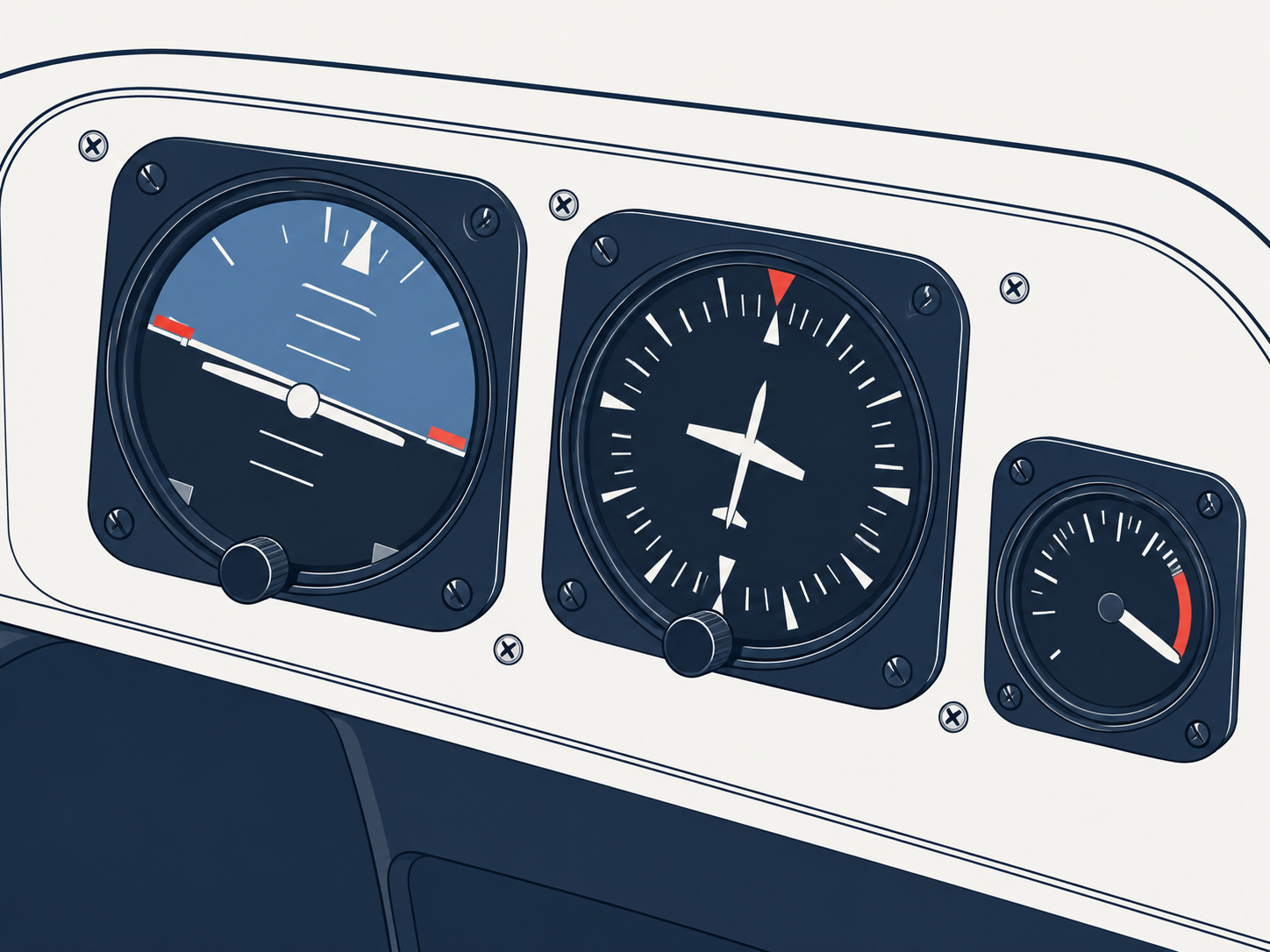
"You're in the clouds and the vacuum pump fails. What's the first thing that looks wrong, and how long until it's really wrong?" Now the student has to run the model. They have to know which instruments are vacuum driven, that the gyros spin down slowly rather than instantly, and that the failure is sneaky because nothing flashes red.
That second question is also, not coincidentally, exactly how a DPE asks it on the oral. Teach the way they'll be tested. If you want to see how examiners actually phrase these, our guide to CFI oral exam prep walks through the pattern.
Less per lesson, more lessons
The most common mistake in teaching aircraft systems is trying to finish the electrical system in one sitting because it's "one topic" in the syllabus.
The handbook is blunt about this. Working memory is small. Pile too much on it and retention drops off a cliff, no matter how well you explained it. You've felt this yourself. Think about the last time someone briefed you on a new avionics suite for forty minutes and you retained the power button.
So split it. Purpose and flow one day. Failures and cockpit indications the next. A five-minute review the day after that, ideally in the airplane with the engine running so the ammeter is actually doing something. If your lesson plans are built in short blocks already, this slots right in.
Three short exposures beat one long one every time. That's not a teaching philosophy. That's just how memory works.
The model is the product
Here's the reframe. You are not teaching the student the electrical system. You are giving them a way to think about any system, so that when they step into a Cirrus or a King Air in five years, they know the questions to ask: what's it for, how does it flow, what happens when it breaks.
That transfers. A parts list doesn't.
And it makes your life easier too. A student with a working model asks better questions, needs less re-teaching, and shows up to the checkride able to reason instead of recite. Examiners notice the difference in about ninety seconds. It's also one of the habits that separates instructors who are just logging hours from the ones described in how to become a flight instructor students actually remember.
Want to see this done live?
We run free Power Hour sessions for CFIs on exactly this kind of thing.
October 3rd 2026, 12pm Eastern Time– Power Hour: Teaching Aircraft Systems That Stick
We'll cover:
The purpose, flow, failure framework applied to the 172 electrical and fuel systems
How to turn a POH systems chapter into a 20-minute lesson block
Symptom-based questioning you can use on the next stage check
What examiners actually listen for on the systems portion of the oral
Register here: Power Hour registration
Absolutely free. No catch. Just show up.
Your student doesn't need every part name.
They need a model that still works at 3,000 feet when something stops.
Build that.
References
FAA Aviation Instructor's Handbook (FAA-H-8083-9), Chapter 3: The Learning Process – faa.gov
FAA Pilot's Handbook of Aeronautical Knowledge (FAA-H-8083-25), Chapter 7: Aircraft Systems – faa.gov