Most pilots who wonder how to become a flight instructor already know the short answer: get a commercial certificate, pass a CFI checkride, start teaching. Three steps, easy to say, and it tells you almost nothing useful about what actually happens between them.
What trips people up isn't the outline, it's the sequencing. Which certificates have to come first, where the Fundamentals of Instructing fits, whether Part 61 or Part 141 changes the timeline, and what the checkride actually tests versus what most applicants spend their time studying (those two things overlap less than you'd hope).
This is the how to become a flight instructor path in the order it actually happens, with the parts that catch people off guard flagged along the way.
What You Need Before You Can Start CFI Training
Before an instructor can sign you off for the CFI checkride, the FAA requires you to hold:
A commercial pilot certificate with the category and class rating you intend to instruct in
An instrument rating, if you plan to teach beyond a sport or recreational pilot ground school (most CFI applicants have this already from their commercial training)
A current medical certificate appropriate to the flying you'll be doing
There's no minimum flight-instructor-specific hour requirement stacked on top of your commercial certificate under Part 61. What you actually need before starting is comfort with the maneuvers and knowledge areas at a teaching level, not just a flying-them level. That distinction is where most CFI training time goes.
Ground School: The Fundamentals of Instructing
Every CFI applicant has to pass the Fundamentals of Instructing (FOI) knowledge test, plus the Flight Instructor Airplane knowledge test if you're going the airplane route. FOI covers how people learn, how to plan a lesson, human behavior, and instructional communication. It's the one part of CFI prep that has nothing to do with flying an airplane, and it's also the part most applicants underestimate.
The FOI material comes from the FAA's Aviation Instructor's Handbook. If you already hold a ground instructor certificate (Basic or Advanced), you're exempt from retaking the FOI knowledge test for your CFI - one of the more useful sequencing shortcuts in this whole process.
Choosing How You'll Train: Part 61 vs. Part 141
Part 61 training is flexible and instructor-driven. You work through the required tasks with your CFI in whatever order makes sense for your schedule, and there's no FAA-approved syllabus governing the pace. Part 141 programs follow an FAA-approved curriculum with more structure and, in some cases, slightly reduced hour minimums for other certificates - though CFI training itself doesn't have a large hour differential between the two paths the way private or commercial training does.
For most working adults training for their CFI on the side, Part 61 is the more common route simply because of scheduling flexibility. Full-time accelerated programs, whether Part 61 or Part 141, compress the same requirements into a shorter calendar window at a faster pace.
What the CFI Checkride Actually Tests
The CFI practical test has two things going on at once: your ability to fly the maneuvers to commercial standards, and your ability to teach someone else how to fly them. The second part is what makes this checkride different from every certificate before it. You're not just demonstrating a steep turn, you're explaining the aerodynamics behind it, the common errors a student will make, and how you'd correct them, all while flying it yourself. This is a big part of why understanding how to become a flight instructor means preparing differently than you did for earlier checkrides. For more on why this checkride trips up so many applicants, see our breakdown of the CFI checkride.
What the Oral Exam Adds to the Equation
The oral portion runs long because the examiner needs to see you teach, not just recite. Applicants who prepared by memorizing answers to expected questions tend to struggle here, because a DPE can ask the same concept five different ways and a memorized answer only survives the first one. The applicants who do well are the ones who can explain a concept cold, from a different angle, without a script in front of them.
How Long Realistic CFI Training Takes
For a pilot training part-time around a job, three to six months from starting FOI ground school to checkride is a realistic range, depending on how often you can fly and how much of the knowledge base you're building from scratch. Accelerated full-time programs compress this to a matter of weeks, at the cost of a much higher daily study and flight load.
The variable that matters more than the calendar is how you spend the time. Applicants who split their prep between flying the maneuvers and actually practicing teaching them, out loud, to a whiteboard, a study partner, or even an empty room, walk into the checkride in a fundamentally different position than applicants who only reviewed material silently.
Common Mistakes That Slow Down CFI Training
A few patterns show up again and again in CFI applicants who take longer than they expected to get checkride-ready:
Treating FOI as a box to check. Applicants who cram the Fundamentals of Instructing knowledge test and move on without absorbing the concepts end up relearning the material later, when it resurfaces during checkride prep in a more demanding form.
Studying maneuvers without practicing the teaching side. Being able to fly a chandelle and being able to teach one are different skills built through different kinds of practice, and applicants who only do the first kind of studying are surprised by how much harder the second kind is.
Scheduling the checkride before the oral prep is solid. The flying portion of a CFI checkride is usually the shorter half. Applicants who front-load their prep toward maneuvers and treat oral prep as something to squeeze in later tend to end up rescheduling.
None of these mistakes are unusual, and none of them are permanent. They're just costly in time if they aren't caught early.
What a Realistic CFI Training Week Looks Like
For a pilot training part-time, a productive week usually mixes three things: dedicated study time working through FOI and maneuver knowledge, flight lessons where you're both flying and narrating what you're doing as if teaching it, and standalone practice explaining concepts out loud, on your own or with a study partner, away from the airplane entirely. Applicants who only do the middle piece, flying with an instructor, and skip the standalone explanation practice tend to plateau earlier, because the airplane doesn't leave much room to slow down and work through a concept from three different angles the way a quiet room does.
The instructors who move through CFI training fastest aren't necessarily the ones flying the most hours. They're the ones who show up to each lesson having already worked through the material once on their own, so the lesson becomes refinement instead of first exposure.
What to Do Next
If you're at the start of this process, the highest-leverage move is getting your FOI and flight-instructor knowledge test material organized before you're deep into scheduling checkride prep with a DPE. CFI Bootcamp's CFI Gaps Course and Online CFI Course are both built around this exact sequence, taking you from "I have my commercial certificate" through checkride-ready, with the teaching-level explanations built in rather than bolted on afterward. Nobody wants to be the applicant relearning steep turns for the fourth time the night before their checkride.
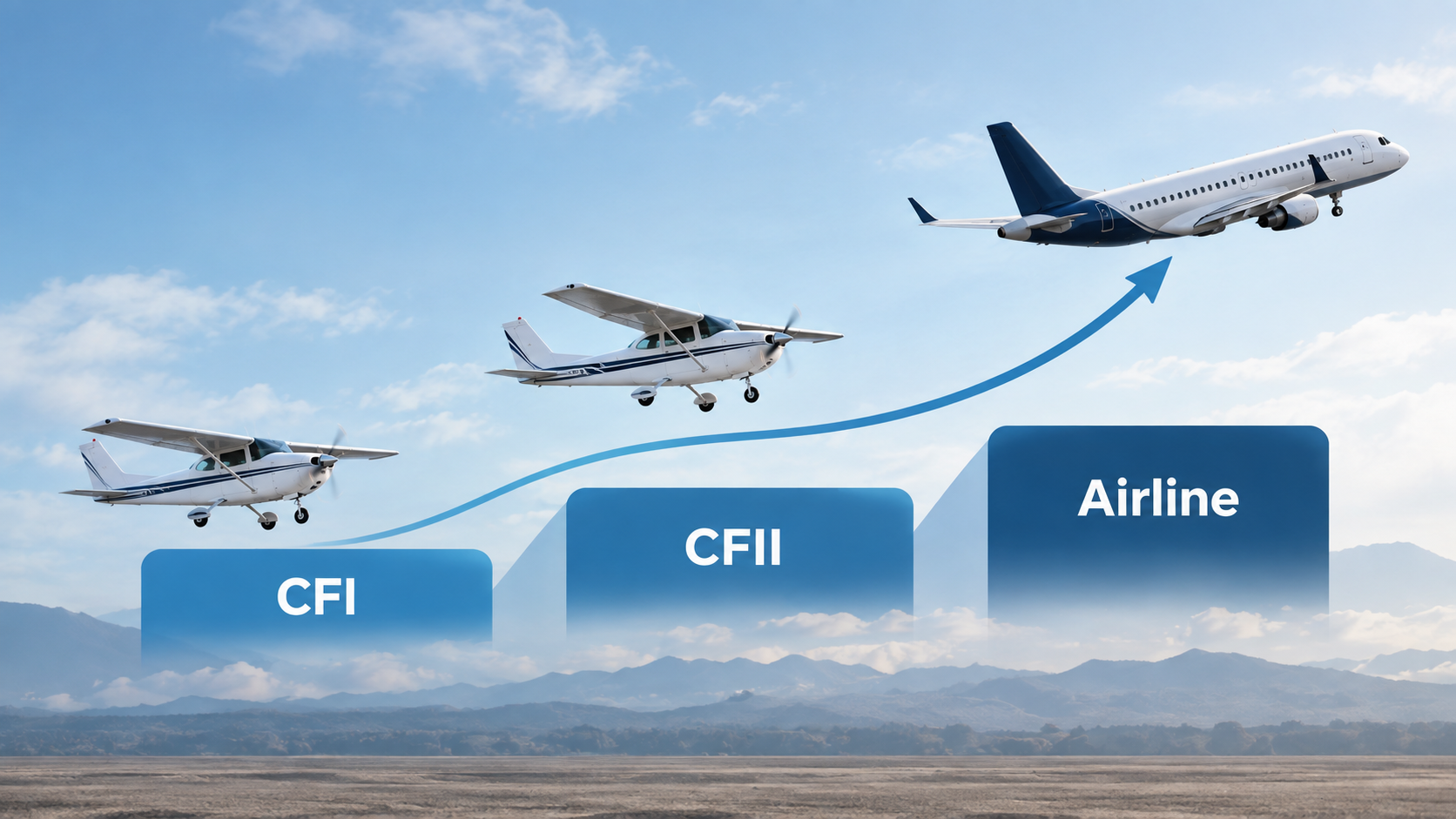
If you are mapping out how to become a flight instructor, the order matters more than the checklist: commercial certificate and instrument rating first, Fundamentals of Instructing ground school next, then CFI-specific flight and oral prep. Once you are certificated, see our guide on the flight instructor salary and career path, or how Part 61 vs Part 141 affects your training timeline. For the official prerequisites, review the FAA's Become a Pilot resource directly.