Loss of control in flight — a stall or spin, usually low and usually in a turn — is the leading cause of fatal accidents in general aviation. Not weather. Not mechanical failure. A loss of aircraft control that the pilot had every tool to prevent.
Ask any pilot what kills people in general aviation and you'll get a confident answer fast: weather. Every CFI's ground school leans hard into it, every checkride oral circles back to personal minimums, and every hangar conversation eventually gets to "the time I should've turned around."
Weather's up there. It's not the top of the list.
Loss of control in flight — LOC-I, if you want the acronym everyone at the FAA meeting used before lunch, isn't close to second place either. And here's the part that should actually bother you: it's not happening to student pilots who don't know better. It's happening to pilots with hundreds of hours who absolutely do.
So let's talk about why knowing the material has never been the problem.
Stall Recognition Isn't the Skill You Think It Is
Every pilot can recite the stall recovery procedure. Reduce angle of attack, add power, level the wings, in whatever order your instructor drilled into you. That's not the skill that's missing. The skill that's missing is noticing you're approaching a stall before the horn goes off, in a configuration nobody practices — a steep turn to final that got a little too steep, a go-around that got a little too aggressive, a downwind turn in gusty conditions that ate more airspeed than you clocked.
Practiced stalls happen in a predictable setup: clean configuration, deliberate entry, plenty of altitude, an instructor watching your instruments. Real loss of control in flight events happen in a turn, close to the ground, when your attention is somewhere else entirely — usually the runway you're trying very hard to make.
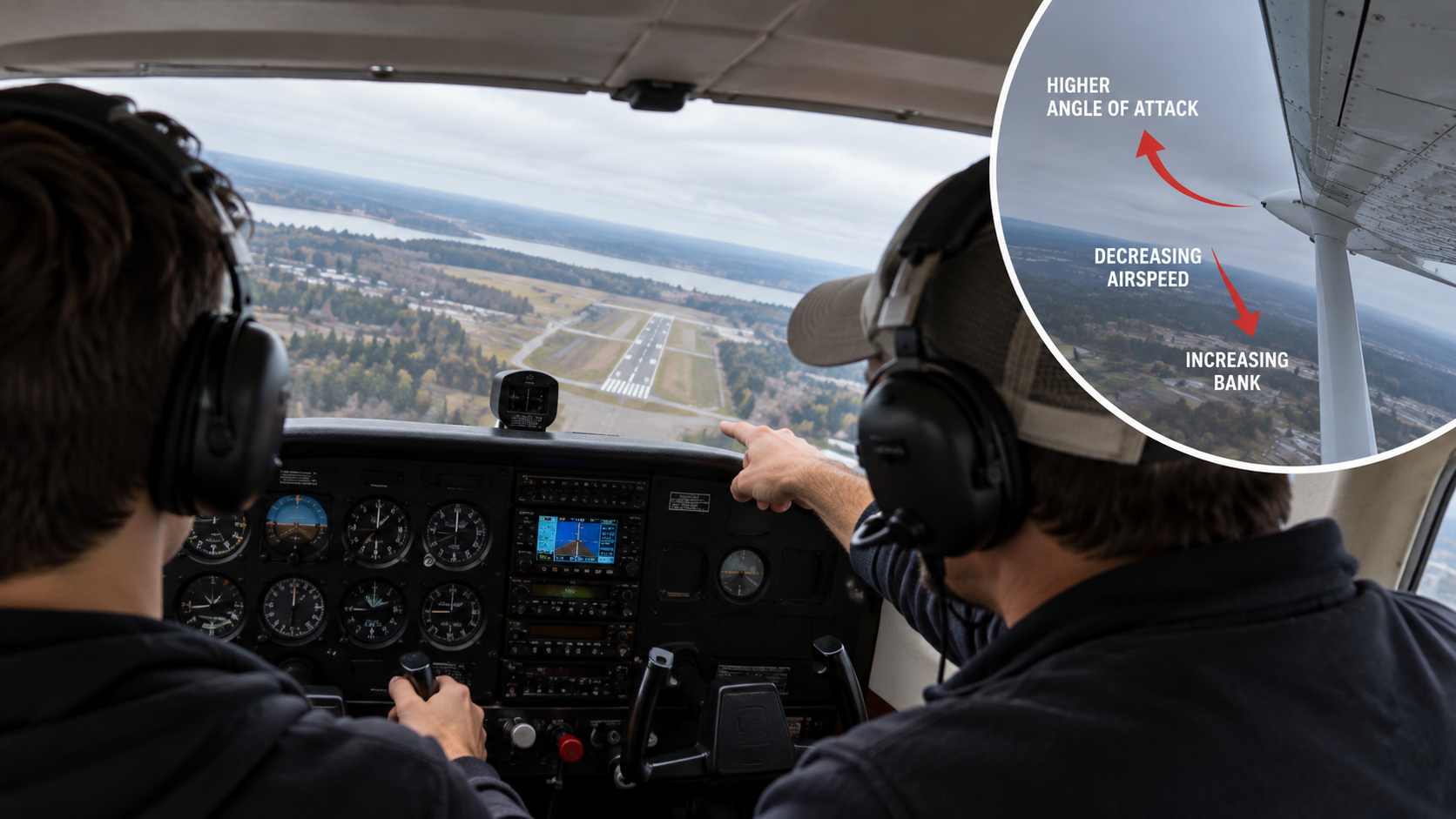
That's the actual gap. Not "does this pilot know what a stall is." Every pilot does. It's "can this pilot feel one coming while task-saturated at 400 feet." Those are two completely different skills, and only one of them gets tested in the traffic pattern under realistic pressure. Miss that skill and you've got the setup for the same stall-spin accident that shows up in the reports year after year, with a different tail number attached.
The Base-to-Final Turn Deserves Its Own Warning Label
If LOC-I accidents had a favorite address, it'd be the base-to-final turn. Airplane's slow, partially configured, the pilot's cross-checking the runway and the wind and the traffic call they just heard, and the turn tightens because the runway "isn't lining up right." Tightening the turn with rudder instead of bank feels like the intuitive fix. It is also exactly how you get an uncoordinated stall that breaks into a spin with altitude you don't have to recover.
This is worth being blunt about: a skidding turn at pattern altitude is not a "be careful" situation. It's a "this specific control input, at this specific moment, produces an unrecoverable outcome" situation. There's no soft version of that sentence that keeps the point intact.
Currency Isn't the Same as Competency Here
A pilot can be perfectly current — recent flight review, recent landings, flying regularly — and still be rusty on the specific skill that prevents LOC-I, because that skill rarely gets practiced outside of primary training. Once the checkride's done, most pilots never intentionally explore the edge of the envelope again. The airplane keeps flying fine for years, right up until a distracted moment in a turn asks a question the pilot hasn't practiced answering in a decade.
This is where flight reviews earn their keep, if the CFI running them treats slow flight and stall awareness as more than a box to check. It's also a reasonable thing to ask for directly the next time you're up with an instructor: not "let's do the stalls I already know," but "put me in the configurations where I've gotten rusty and let's see what I actually notice." If you want a structured way to build this awareness before your next flight review, it is covered inside the Bootcamp+ Basic free membership.
What Actually Moves the Needle
None of this is solved by a poster in the FBO or a slogan. It's solved by deliberately practicing the uncomfortable version of the skill — slow flight with distractions, stalls from realistic configurations instead of the clean textbook setup, and turns that get a little too tight on purpose, with an instructor who knows how to let you find the edge safely instead of avoiding it entirely.
If you're a CFI, this is also the exact area where your own currency matters more than your logbook total. Teaching stall awareness well requires being comfortable enough in the maneuver yourself that you can watch the student's scan instead of narrating your own checklist. That's a specific, practicable teaching skill, and it's one of the areas we spend real time on in Power Hour Lessons.
The Uncomfortable Truth Worth Sitting With
Loss of control in flight isn't an accident category that happens to careless pilots. It happens to pilots who were current, competent by every normal measure, and simply hadn't practiced the specific moment that mattered in years. That's a fixable gap. It just requires admitting it's there instead of assuming experience alone covers it.