You filed VFR. Ceiling's legal, visibility's legal, and there isn't a cloud between you and the destination that you plan on flying through. So carburetor ice and the rest of the icing briefing feel like somebody else's problem today, that's an IFR conversation, for the poor soul shooting an approach into an overcast you wouldn't fly a kite in.
That's the assumption. It's also wrong, and it's wrong in a way that's put more than a few VFR-only pilots into accident reports they never saw coming.
Icing doesn't check your flight plan before it forms. It checks the air. And there's a longer list than most VFR pilots realize of ways to pick up ice, lose power, or lose lift without ever filing an IFR flight plan or entering a cloud.
Structural Ice Doesn't Require IMC | Just Visible Moisture and Cold
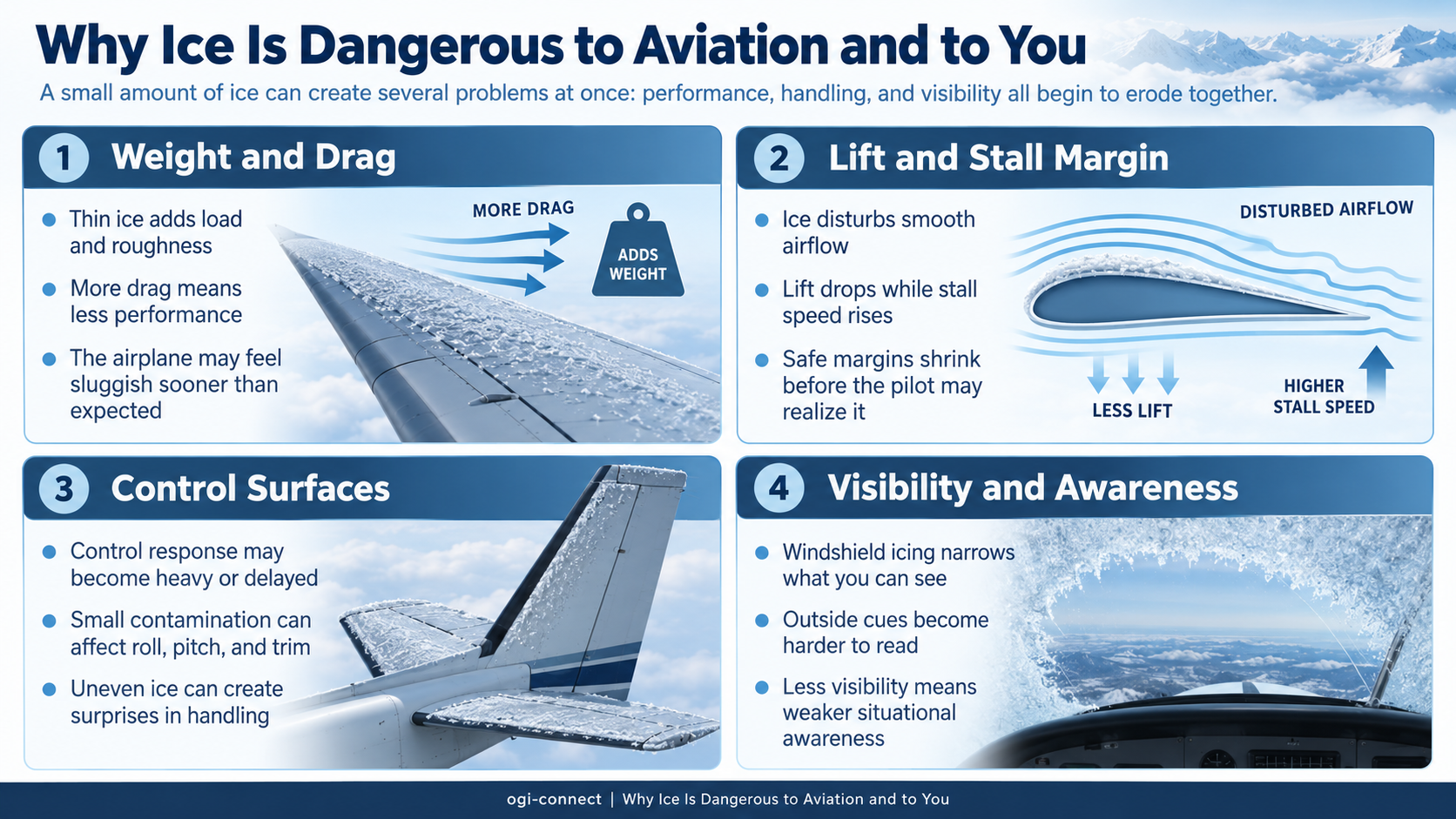
Here's the part that gets lost in primary training: structural icing needs visible moisture and a temperature near or below freezing. It does not need you to be inside a cloud.
How Ice Forms Below a Cloud Deck in Clear Air
Freezing rain and freezing drizzle can fall out of a warm layer aloft and reach you in clear air underneath it, well below the cloud base. You're VFR, you're in the clear, and the airplane is picking up ice anyway, because the precipitation didn't stop being cold just because it stopped being inside a cloud.
Why Freezing Level Alone Doesn't Tell the Whole Story
Brushing the base of a scattered or broken layer does the same thing on a smaller scale. You don't have to punch through a deck to get wet, a wingtip clipping the bottom of a cumulus buildup on a cold day is enough moisture, for enough time, at the wrong temperature. Virga underneath a building cell works the same way. None of this requires a clearance, a hood, or six hours of actual instrument time. It requires cold, wet air and a pilot who assumed the sectional's cloud symbols were the whole story.
It also helps to know what you're looking at once it's on the airframe. Rime ice is the rough, milky-white buildup you get from small supercooled droplets freezing fast, it's the most common type and the one most VFR encounters produce. Clear ice, sometimes called glaze ice, comes from larger droplets that spread out before freezing; it's harder to see and sheds worse aerodynamic penalties for the same thickness. Mixed ice is both at once, and it's exactly as ugly as it sounds. None of the three cares whether your flight plan says VFR.
Carburetor Ice Is Probably the One That's Actually Going to Get You
Structural ice gets the airframe posters. Carburetor ice is the one quietly taking down VFR trainers on a Tuesday afternoon.
Carb icing can form in visible humidity at outside air temperatures up to around 70 degrees Fahrenheit, no cloud required, no precipitation required, sometimes no obvious moisture required at all. It's a pressure and temperature-drop problem inside the carburetor throat, and it happens on exactly the kind of cool, humid, hazy-blue-sky day that feels like the safest flying weather of the month.
This is a VFR-specific threat because VFR training happens in carbureted trainers, 172s, Cherokees, Warriors, on exactly those mild, humid days. A student pulls carb heat during the pattern because it's on the checklist, not because they believe ice is actually forming, because nothing about the sky in front of them looks dangerous. That gap between what the sky looks like and what's happening inside the carburetor is where a rough-running engine on downwind turns into a very quiet conversation with an examiner.
Which Conditions Put You in the Highest-Risk Window
Here's the range worth putting in front of students, straight from the FAA's own carburetor ice guidance:
Outside Air Temperature | Relative Humidity | Icing Risk |
|---|---|---|
Below 70°F (21°C) | Above 80% | Icing probable, the FAA's standard threshold |
20°F to 70°F (-7°C to 21°C) | High humidity | Serious icing possible at any power setting |
Above 70°F | Very high humidity | Still possible, though less common |
That 70-degree number is the one students never expect. It means carb ice is a threat on a genuinely pleasant flying day not just the cold ones and it's exactly why "the sky looks fine" is worthless as a carb-ice indicator.
The Icing Products You're Skipping Because "I'm VFR"
AIRMET Zulu, icing PIREPs, and the freezing level charts get treated like IFR paperwork in a lot of VFR preflight briefings. They're not. They're relevant to anyone flying in cold, moist air regardless of what's on the flight plan.
An AIRMET Zulu covering your route at your cruise altitude is telling you something true about the air mass whether you're VFR, IFR, or flying a kite. A PIREP reporting light rime at 6,500 is useful information if you're planning to cruise at 6,500 VFR under a scattered layer, not just if you're filing to 6,500 on an IFR flight plan. Skipping these products because you don't intend to be in the clouds isn't a shortcut. It's just skipping information about a hazard that doesn't care about your intentions.
Ground Ice Doesn't Wait for You to Take Off
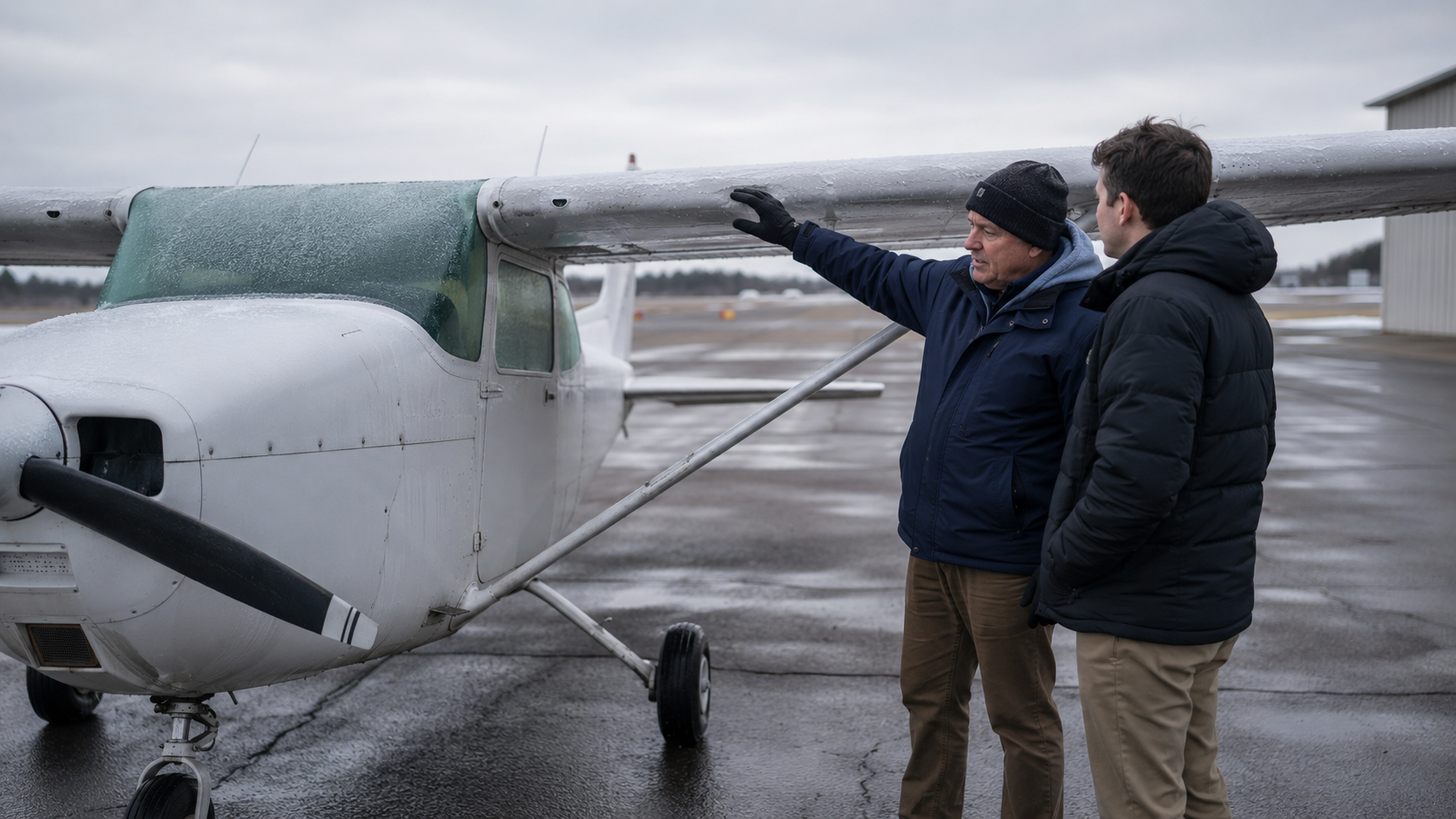
Frost on the wing before departure is a VFR problem too, and it's the one that requires no atmospheric conditions at all beyond a cold, clear morning and dew. A thin, sandpaper-rough layer of frost across the upper wing surface disrupts airflow enough to meaningfully raise stall speed and cut climb performance on an airplane that hasn't left the ramp yet.
The airplane fails its own preflight before you ever add power. And because it's a beautiful, clear VFR morning with unlimited visibility, it's exactly the kind of day a pilot glances at frost, decides it's "just a little," and launches anyway.
The Reframe Worth Teaching
Icing isn't an IFR hazard that VFR pilots get to skip. It's a cold-and-moist-air hazard that IFR pilots happen to encounter more often, because instrument flying puts them in the clouds more frequently. The physics don't check your certificate.
The VFR pilots who actually stay ahead of this aren't the ones who've memorized which cloud types carry the most risk. They're the ones who've stopped using "I'm VFR today" as a reason to skip the icing briefing altogether.
That's a five-minute habit. It's a lot cheaper than the alternative.
Related reading: Flight Instructor Liability Gaps Every CFI Must Know, CFI Training Gaps That Show Up on the First-Time Checkride, and IFR Clearance in the Real World: The CFI's Complete System.
Join Us for the Next CFI Bootcamp Power Hour
If any of this changed how you're going to brief your next cold-weather flight, good. That's the point.
We're covering VFR-specific weather hazards in full at the next CFI Bootcamp Power Hour not the textbook version, the version that shows up in real preflight decisions.
September 5th, 2026 - 12pm ET | Icing for VFR pilots - The threats you can still encounter without flying IMC
We'll cover:
Where structural icing shows up outside of IMC, and how to brief for it on a VFR flight
Why carb ice is the most underrated hazard in VFR trainers, and how to actually catch it early
Which icing products matter even when you're not filing IFR
How to teach students to stop treating "VFR" as a reason to skip the cold-weather briefing
Absolutely free. No catch. Just show up.
👉 Register here: https://cfibootcamp.kartra.com/page/Power-Hour-Lessons-Show
Bring your real questions. Leave the textbook answer at home.