Every instrument student can read back a clearance perfectly in the practice room. Then the real one comes over the radio, half-garbled, at 4,000 feet in actual weather, and you watch the wheels come off.
Sweaty forehead. Death grip on the yoke. That look — the one from every disaster-movie cockpit scene where the character's clearly regretting every decision that got him there. If you've instructed IFR students for more than a month, you've seen that face. You may have made that face. Thats IFR clearance in the Real World.
Here's the uncomfortable truth: "three steps ahead or you're behind" isn't a mindset problem. It's a systems problem. Nobody taught a repeatable way to stay ahead — they taught the checkride version of IFR and hoped real-world pattern recognition would show up on its own. It doesn't. Not without a framework.
This is that framework — the one CFI Bootcamp actually teaches, straight from a recent Power Hour session on flying IFR the way ATC and the airplane actually expect it, not the way the practice test does.
Can You Even Accept That Clearance?
Before your student worries about being three steps ahead, they need to clear a lower bar: are they legal to be in the airplane at all.
Do they hold the certificate and rating. Obvious, but it's the first checkbox for a reason — skip it and nothing else matters.
Are they IFR current under 61.57. Six approaches, holding procedures, and intercepting/tracking courses, all within the preceding six months. Miss that window and a safety pilot can get them current again — but they still can't fly IFR until they are.
Have they done an IPC if currency lapsed past six months. An Instrument Proficiency Check isn't optional paperwork. It's a full proficiency check across preflight procedures, ATC clearances and procedures, flight by reference to instruments, navigation systems, approach procedures, emergency operations, and postflight procedures — and most of it can be done in an AATD, with a few tasks (circling, landing, multiengine items) requiring the aircraft or a higher-level sim.
Teach this as a pre-flight legality check, not a footnote. A pilot who's rusty on currency math is a pilot who's already behind before the clearance is even read.
The Real Problem With "Three Steps Ahead"
Flying reactively — chasing the airplane instead of leading it — does three predictable things: it spikes anxiety for the pilot and everyone in the cabin, it manufactures busywork that didn't need to exist, and it turns a normal approach into a stress event.
None of that is inevitable. It's what happens when a pilot has no structure for when to think ahead and what to think about. Fix the structure, and the anxiety mostly fixes itself.
That structure comes down to four things: knowing where you are and how fast you're going, recognizing when you're roughly 15 minutes from high workload, having a mnemonic that organizes the brief so nothing gets missed, and anticipating what the controller — or you — will likely need to do next.
The 15-Minute Rule
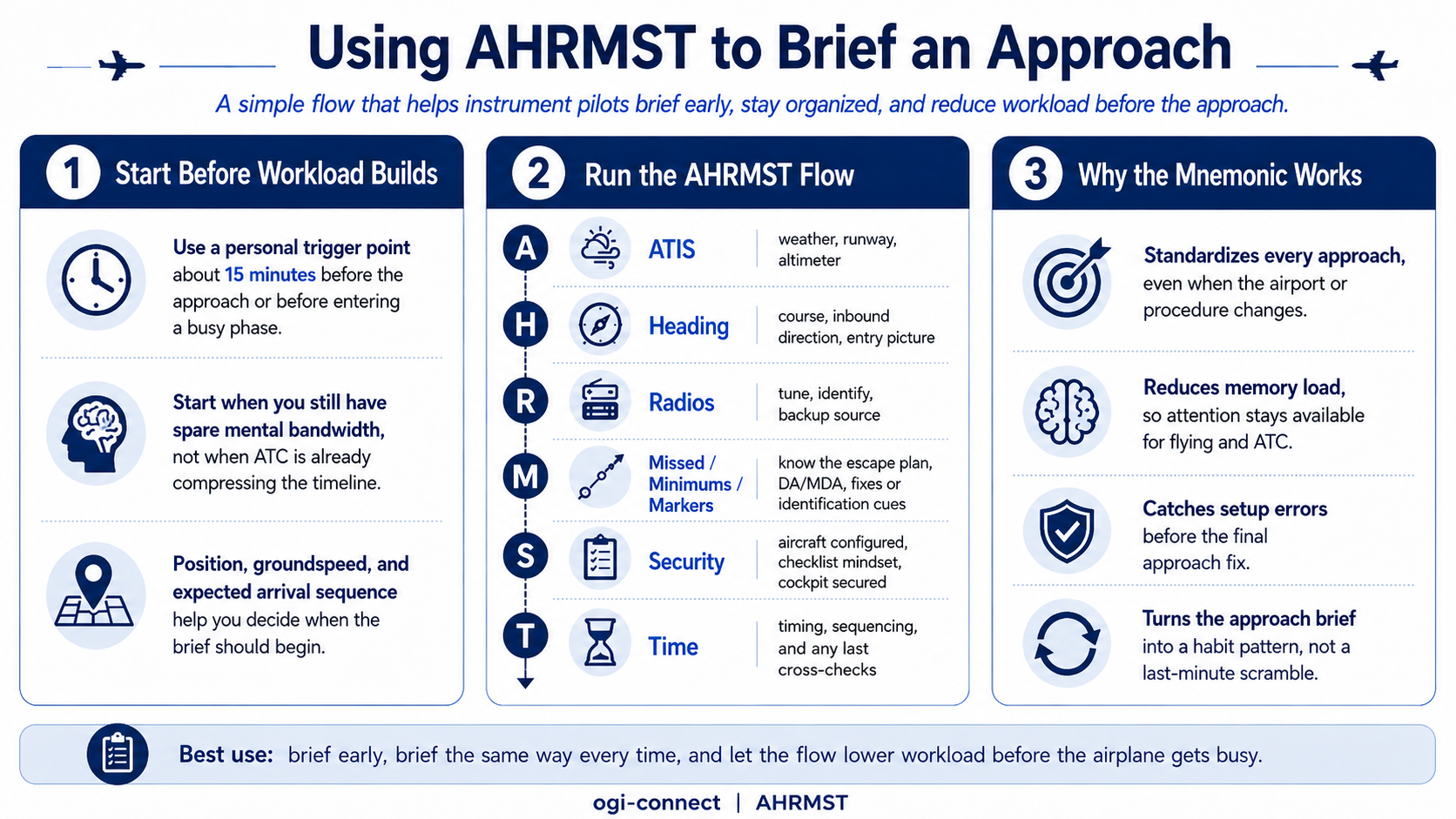
Fifteen minutes out from the approach is the trigger to set up and brief, before the workload spikes. That's the point to figure out whether this will be a vectored approach or a pilot-nav approach, because they behave differently.
Vectors typically run downwind, base, then an angled final — and the approach gate matters here: it sits within one mile of the FAF and at least five miles from the runway threshold, and ATC isn't supposed to vector you to final inside that gate. If your student doesn't know where that gate is, they won't recognize when a vector is unusual.
Pilot-nav approaches raise a different question early: is the IAF a course reversal — procedure turn, or hold-in-lieu — or is it a crossing clearance to a fix that isn't an IAF, which means a feeder route is required. Sorting that out at the 15-minute mark, not the 3-minute mark, is what keeps a student from getting surprised.
AHRMST: The Brief That Actually Works
Give students a mnemonic and workload drops immediately, because now there's a checklist instead of a vague feeling of "am I ready."
AHRMST — ATIS, Heading, Radios, Missed approach, Minimums, Markers, Security, Time. Run through it at the 15-minute point and the brief is done before the workload ever spikes. It's not glamorous. It's also the difference between a pilot who's set up and a pilot who's improvising at 200 feet AGL.
Reading the Plate for the Weird Stuff
Three things trip up otherwise-solid instrument pilots, and all three live in the fine print of the approach plate.
Weird minimums. High visibility requirements paired with unusually high minimums are a signal, not a typo — go check the missed approach procedure for a climb gradient or terrain restriction driving that number.
Climb gradients. These show up in the takeoff minimums section or the missed approach notes, and they're based on groundspeed — which means a turning missed approach with a tailwind component changes the math. The quick conversion: (groundspeed ÷ 60) × feet-per-NM = feet-per-minute required. Easy mental math shortcut — 60 knots is 1 NM/min, 90 is 1.5, 120 is 2.
Timed approaches. Rare outside the U.S. but still charted, and they exist to let a pilot identify the missed approach point from the FAF using time instead of a fix — again based on groundspeed, so headwind and tailwind both matter.
None of these are exotic. They're just easy to miss when a pilot's already behind — which is exactly why teaching students to catch them before they're behind is the whole point.
The Real Skill Isn't Confidence. It's a System.
"Just relax and trust your training" has never fixed a behind-the-airplane pilot, because the problem was never nerves — it was the absence of a repeatable process. Teach the four things. Teach the 15-minute trigger. Teach AHRMST. Teach students to read a plate for what it's not telling them plainly.
Do that, and "three steps ahead" stops being a personality trait some pilots have and others don't. It becomes something every properly trained instrument pilot can do, every time, on command.